Cookware
COOKLIFE 10-Inch Cast Iron Skillet Review: 30% Lighter
Thirty percent less iron, a machined cooking surface and a stainless lid. Thin iron is a different tool, not a better one.
Affiliate disclosure: Some links on this page are affiliate links. If you buy through them, we may earn a commission at no extra cost to you.
Prices change daily — check the current price on the listing.
See this skillet on AmazonOpens the retailer's product page. Commission may be earned.
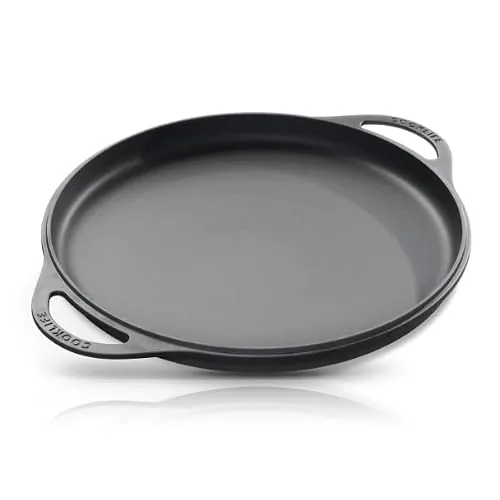
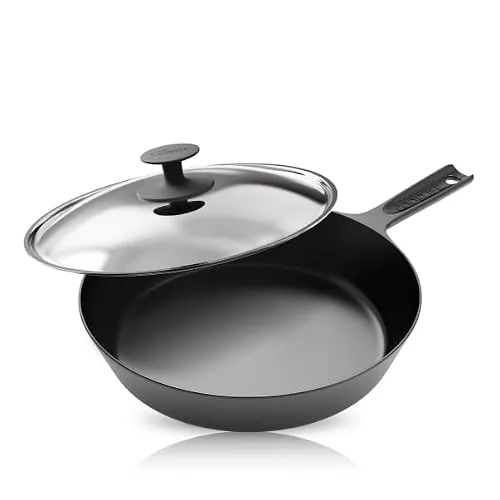
Cast iron is normally sold on mass — weight is the feature. This one is sold on the opposite: 30% lighter than traditional cast iron, plus a polished cooking surface and a stainless lid. All three change how the pan behaves, and only two of them are unambiguous improvements.
We have not cooked in it. The claims, rating count and price position below come from the listing, read on November 13, 2026.
What 30% lighter actually changes
The brand sells it as 30% lighter. If that claim holds, thirty percent less iron is thirty percent less thermal mass, and thermal mass is what changes the physics.
- Faster response. The pan heats sooner and cools sooner, behaving closer to carbon steel than to a heavy five-and-a-half-pound skillet.
- Less stored heat. Put a cold steak into a heavy pan and the surface temperature barely moves. Put it into a thin pan and the surface drops, then has to recover. Thin iron rewards a longer preheat, not a hotter one.
- One-hand handling. Less wrist strain, easier to tilt and spoon.
- Hotter handles, sooner. Less mass to absorb heat, so the handle reaches uncomfortable temperatures faster. Use a towel.
The load you put on the stovetop is the same. What changes is the reserve: a heavy skillet cooks four burgers in sequence without dropping temperature, and a light one wants them in two batches.
The polished surface is the more interesting upgrade
The listing describes a fine polishing technique that makes the surface smoother than traditional cast iron, so seasoning oil spreads more evenly, the seasoning layer forms faster, and food sticks less. That matches how bare iron works: texture gives food something to grip, and a machined surface gives seasoning a flat substrate.
Two corrections worth making to the listing's language. Polished is not nonstick — a smooth pan with no seasoning layer will stick to eggs as surely as a rough one. And pre-seasoned is not seasoned: the factory coat is a thin starter layer, and the first month of fatty cooking builds the real one.
The listing also states the polished surface works well on glass cooktops. That is a specific, useful claim: rough iron can scratch a glass top, and smooth iron is far kinder to one.
The stainless lid is unusual, and it is the right call
Most covered skillets ship with glass. Stainless survives oven heat, drops and the dishwasher, and it turns the skillet into a shallow braiser. The trade is that you cannot see through it — and in a skillet, unlike a pot, you are watching browning almost constantly, so you will lift the lid more often than you would with glass.
Check the knob and any handle material before putting the lid in a hot oven; the lid body is metal, but fittings are not always.
Ten inches is the workhorse size
Two chicken breasts, three eggs comfortably, one steak with room to sear, or a pan of vegetables for two. It fits a standard burner without overhanging, and fits an oven rack without blocking the door. Eight inches is a one-person pan; twelve inches browns more at once and takes both hands.
Ratings, and the price position you should see
4.4 stars across 66 ratings, carrying Amazon's Choice and a twenty percent discount against list price. Sixty-six ratings is a modest sample, but cast iron's failure modes are well understood — seasoning, rust, handle heat — so the average is more informative here than it would be for an appliance.
On the same page Amazon shows a 15-inch pre-seasoned skillet with 14,573 ratings at a much lower price. It is heavier, rougher, and vastly better sampled. Buy this one for the weight and the surface, not for value per dollar.
What real owners say
Across 66 global ratings on Amazon, the COOKLIFE 10-inch skillet averages 4.4 stars, with 68 percent of buyers giving it five stars and only 6 percent leaving one-star reviews. The strongest praise comes from owners who expected the usual heavy cast-iron experience and were surprised: the polished surface seasons faster than rough cast iron, and the 10-inch weight is light enough for older users to lift one-handed.
The recurring compliments are specific: eggs release cleanly after a short seasoning period, the stainless lid stays secure on the rim, and the handle does not get hot on a gas stove. Several owners mention buying it specifically because the light weight solves the problem of traditional cast iron being too heavy for daily cooking.
The handful of complaints are minor. One owner noted receiving silicone handle grips instead of the leather handle wraps shown in the photos, and a few users mentioned the pan needs more frequent seasoning than a fully pre-seasoned Lodge. None of the negative reviews reported warping, rust, or handle failure — the failure modes that matter most with cast iron.
Sample size is small at 66 ratings, but cast iron's failure modes are well understood, so the average is more informative here than it would be for an appliance.
Who should buy it
- Cooks who want iron's sear without lifting a two-hand pan.
- Anyone moving off coated nonstick onto a surface that cannot flake into their food.
- Stovetop-to-oven cooking, given the stainless lid — and glass cooktop owners, given the polished base.
Do not buy it for maximum heat retention on thick steaks, or if you expect bare iron to behave like a coating on day one. Neither of those is what a thin polished skillet is for.
The short version
Thinner, smoother, easier to lift — a skillet that trades heat reserve for control, and asks you to preheat properly in exchange. Season it well and it behaves like bare iron should — no coated-pan comparison is claimed here.
Thin iron is faster, not weaker. It just asks you to preheat.
Frequently asked questions
Is lightweight cast iron as durable as traditional cast iron?
Not established. Thinner walls change heat behavior, and a thin wall is more sensitive to thermal shock. The material is the same, but long-term durability at this wall thickness is not documented.
Is the polished surface nonstick?
No. It reduces sticking once seasoned; it is not a coating and it does not release food on its own.
Can the stainless lid go in the oven?
The lid body is stainless; check the knob and fitting material before using it above moderate heat.
Does it work on induction?
Cast iron is ferromagnetic, so yes — provided the base is flat enough to make contact.
How long until the pan is properly seasoned?
Roughly a month of regular fatty cooking, sooner if you fry often.
How many ratings does it have?
4.4 stars across 66 ratings, with Amazon's Choice and a 20% discount against list price as shown on November 13, 2026.
Sources
- Retail listing (ASIN B0DNMTY4MC) — 4.4 stars / 66 ratings, 10 inch, pre-seasoned cast iron, stainless steel lid, polished surface, Amazon's Choice, 20% off list price, checked November 13, 2026
- Also on the same page: 15-inch pre-seasoned skillet, 14,573 ratings, lower price, read November 13, 2026
- Listing highlights: "30% lighter than traditional cast iron skillets", "polished surface works great on glass cooktops", "comes pre-seasoned and ready to cook immediately"
- Listing bullet: fine polishing technique makes the surface smoother than traditional cast iron, letting seasoning oils spread more evenly and building a seasoning layer faster
How this page was researched
This is a research-based review, not a hands-on test. We have not bought or cooked with this pan. Star rating, rating count, size, materials and discount status come from the listing page read on November 13, 2026; the comparison skillet figures come from a listing displayed on the same page. The heat-behavior discussion is standard thermal reasoning about wall thickness, not a measured result. No prices are quoted because they change daily.