Cookware
Magnifique 4.5-Quart Clay Pot Review: Oven-Safe Dutch Oven
The listing says no chemical coatings and no PFAS. Very little tolerance for thermal shock. What clay does that coated ceramic cannot, and what it demands in return.
Affiliate disclosure: Some links on this page are affiliate links. If you buy through them, we may earn a commission at no extra cost to you.
Prices change daily — check the current price on the listing.
See this clay pot on AmazonOpens the retailer's product page. Commission may be earned.
The listing says no chemical coatings, no nonstick layer and no PFAS — and the pot tolerates thermal shock poorly. A clay pot cooks by storing heat instead of passing it through quickly, which makes it the odd one out among every coated pan reviewed on this site.
We have not cooked in it. The specification, claims and rating count below come from the listing, read on November 13, 2026.
What the listing actually promises
- Clay retains heat for deeper, richer flavors. That is the material doing its job: high thermal mass means the pot keeps cooking after the burner is down, which is how a stew gets its second hour for free.
- No PFAS, PTFE, chemical coatings, lead or heavy metals. That is the listing's claim about the material. A sealed clay surface is not the same as a certified coating-free glaze, so ask the seller for test reports if lead or heavy metals matter to you.
- Oven and stovetop safe. The listing names oven, gas stove and electric stovetop. It does not discuss induction — so if induction is your only heat source, confirm compatibility with the seller before ordering.
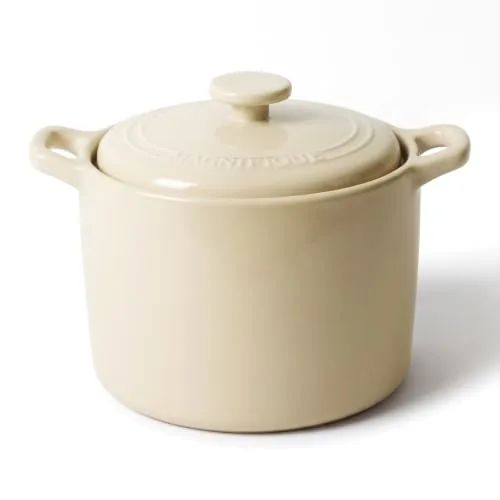
- Dutch-oven style, 4.5 quarts, stone color. A lidded braising vessel with two handles and a knobbed lid.
Also on the page: 4.7 stars across 12 ratings, and the note that the product is new to Amazon within the past three months. Twelve ratings cannot establish durability, and durability is the only question that really matters with clay.
What 4.5 quarts holds
Four and a half quarts is eighteen cups — one quart more than the four-quart slow cooker covered separately, and the classic Dutch-oven capacity.
- A five-pound chicken, or a three-pound chuck roast with vegetables around it
- A stew for six, double batch
- Dry beans, cooked from soaked, with room to swell
- Stovetop rice for four
- Bread, if the lid seals and the oven is moderate — check the listing's temperature guidance first
It is tight for four people who want a main and a side in the same pot. It is right for a braise, a stew, or a pot of beans that is meant to be the meal.
The habits that stop cracking
Clay fails from thermal shock, not from heat.
- Never heat it empty, and never heat it fast. Fat or liquid in first, low flame, gradual ramp. A dry clay pot on a hot burner is the fastest way to lose it.
- Never cool it fast. No cold water into a hot pot, no cold stone counter under a hot pot, no oven-to-sink transfer. Let it sit on a trivet.
A third habit follows from the first two: no dishwasher unless the listing explicitly allows it. Detergent plus a hot drying cycle is often the shortest route to a hairline crack.
Before the first use, follow the listing's care note. Many clay pots ask for a soak or a slow, gentle warm-up, and a rushed first heating is how a pot gets its first hairline crack.
Clay versus coated ceramic versus cast iron
A coated pan is metal with a sprayed layer on top: it responds to the dial immediately, and the layer is a wear item. A clay pot is clay with a sealed surface: it responds slowly, holds heat, and has no sprayed nonstick layer to scratch — its failure mode is a crack, not a flake. Enameled cast iron sits between them: heavier, faster to respond, far more forgiving of abuse, and it sears.
For slow, wet cooking, clay is the better vessel. For sear-then-braise in one pot, cast iron is. For anything you might drop, neither is ideal and the coated pan wins on price.
Price and rating context you should know
On the same page Amazon shows a competing 4.5-quart claypot with 282 ratings at a much lower price, and a larger Magnifique clay pot with 51 ratings above it. This listing sits between them with 12 ratings and is marked new.
If clay is new to you, a pot with a longer track record is the lower-risk purchase; buy this one when the stone color, the exact 4.5-quart shape, or the current coupon is what you are after — not because 4.7 stars means more than twelve people.
Who should buy it
- Cooks who braise, make beans from dry, or cook rice on a stovetop and want a pot that goes oven-to-table.
- Anyone replacing coated cookware specifically because of the coating.
- Households where a pot is equipment to be looked after, not a tool to be abused.
Do not buy it for searing on high heat, for induction, for a dishwasher kitchen, or if you have broken a ceramic pot before and know your habits have not changed.
The short version
A simple material with no sprayed layer to flake, and one demand in return — treat it like clay, and confirm your stovetop type first.
A coated pan fails gradually. A clay pot fails all at once, and only if you rush it.
Frequently asked questions
Is it safe on an induction cooktop?
The listing specifies oven, gas and electric. Induction is not mentioned, so confirm compatibility with the seller before buying for an induction-only kitchen.
Is it really PFAS-free?
The listing states no PFAS, PTFE, chemical coatings, lead or heavy metals. Treat that as the seller's claim: clay bodies and glazes can carry lead, so ask for test reports if this matters to you.
Does a clay pot need seasoning?
The listing describes a sealed surface. Follow its care note; if none is given, cook something wet first rather than something sticky.
Why do clay pots crack?
Almost always thermal shock: heated empty, heated too fast, or cooled with cold water while still hot.
Is 4.5 quarts enough for four people?
Yes for a braise, stew or bean pot as the main course. Tight if you want the side dish in the same vessel.
How many reviews does it have?
4.7 stars across 12 ratings, and the listing is new to Amazon within the past three months, as shown on November 13, 2026.
Sources
- Retail listing (ASIN B0HFRP4Z75) — 4.7 stars / 12 ratings, 4.5 quarts, natural clay, PFAS-free, oven and gas/electric stovetop, stone color, new to Amazon within three months, checked November 13, 2026
- Listing bullets: no PFAS, PTFE, chemical coatings, lead or heavy metals; "oven & stovetop versatility ... in the oven and on gas or electric stovetops"; deep 4.5-quart design
- Competing listings shown on the same page: 4.5-quart claypot at 282 ratings, Magnifique 5-quart clay pot at 51 ratings, read November 13, 2026
How this page was researched
This is a research-based review, not a hands-on test. We have not cooked in this pot. The rating count, star average, capacity, materials claims and stovetop compatibility wording come from the listing page read on November 13, 2026; competing ratings come from listings displayed on the same page. The care guidance is general clay-pot practice, not manufacturer instruction. No prices are quoted because they change daily.