Cookware
Ceramic vs Stainless Steel Cookware: Which One Actually Lasts?
One is a coating that wears out. The other is metal that doesn't. That single difference decides how each pan fails, how hot you can safely cook, and what it really costs per year.
Affiliate disclosure: Some links on this page are affiliate links. If you buy through them, we may earn a commission at no extra cost to you.
Ceramic nonstick is sold as the clean, easy-release option. Stainless steel is sold as the professional, buy-it-once option. Both descriptions are roughly accurate, and both hide the same thing: these two materials fail in completely different ways, on completely different timelines. If you understand the failure mode, the choice stops being about brand or price.
Prices change daily — check the current price on the listing.
See a ceramic set at AmazonOpens the retailer's product page. Commission may be earned.
Quick verdict
- Buy ceramic nonstick if: you want low-fat cooking with easy cleanup, you cook mostly at medium heat, and you accept replacing the pan every two to three years.
- Buy stainless steel if: you sear, roast, or cook at high heat, you want one pan for a decade or more, and you are willing to learn proper preheating.
- The number that matters: cost per year of use, not cost per set. A mid-priced ceramic set replaced every two years costs more annually than a stainless set kept for ten.
- The catch: most ceramic listings never state the maximum temperature the coating tolerates. That single missing number is what determines whether the pan lasts two years or five.
What the labels are actually describing
"Ceramic cookware" is a slightly misleading phrase. The pan body is almost always aluminum, because aluminum is light and conducts heat quickly. Ceramic refers to the coating: a sol-gel layer sprayed onto that aluminum body and cured, which is what gives the pan its release. There is no ceramic pot in the way a ceramic dinner plate is ceramic. It is a thin film, measured in tens of microns, sitting on metal.
Stainless steel cookware is the opposite approach. There is no coating at all. Most quality stainless pans are a clad sandwich — a stainless cooking surface, an aluminum or copper core for heat spreading, and a stainless exterior that works on induction. What you cook on is the metal itself, and the metal does not wear off.
That is the whole structural difference. Everything else — the release, the heat limit, the weight, the cleaning routine, the lifespan — follows from the fact that one product is a surface treatment and the other is the material.
How each one actually fails
This is where the honest comparison happens. Neither material is "better"; they break differently, and the way they break determines what you get for your money.
Ceramic nonstick fails progressively. The coating does not crack off in one dramatic moment. It scratches, then stains, then gradually stops releasing. The turning point is when eggs need oil again — once that happens, the pan is on its way out. Because the coating is applied at the factory, there is no repair: a compromised ceramic pan is a disposable pan. With daily use, most reach that point in one to three years.
Stainless steel does not wear out the way a coating does. The metal itself does not erode; its failure modes are almost all cosmetic or fixable, though pans can warp and handles, lids and seals carry their own limits. Thin pans warp on a hot burner. High heat leaves a rainbow tint that looks permanent but polishes off. Handles loosen if the rivets were cheap. Polymerized oil builds a brown film if you never degrease the pan properly. None of these stop the pan from cooking, and all of them are visible in the owner complaints of any stainless set you look at.
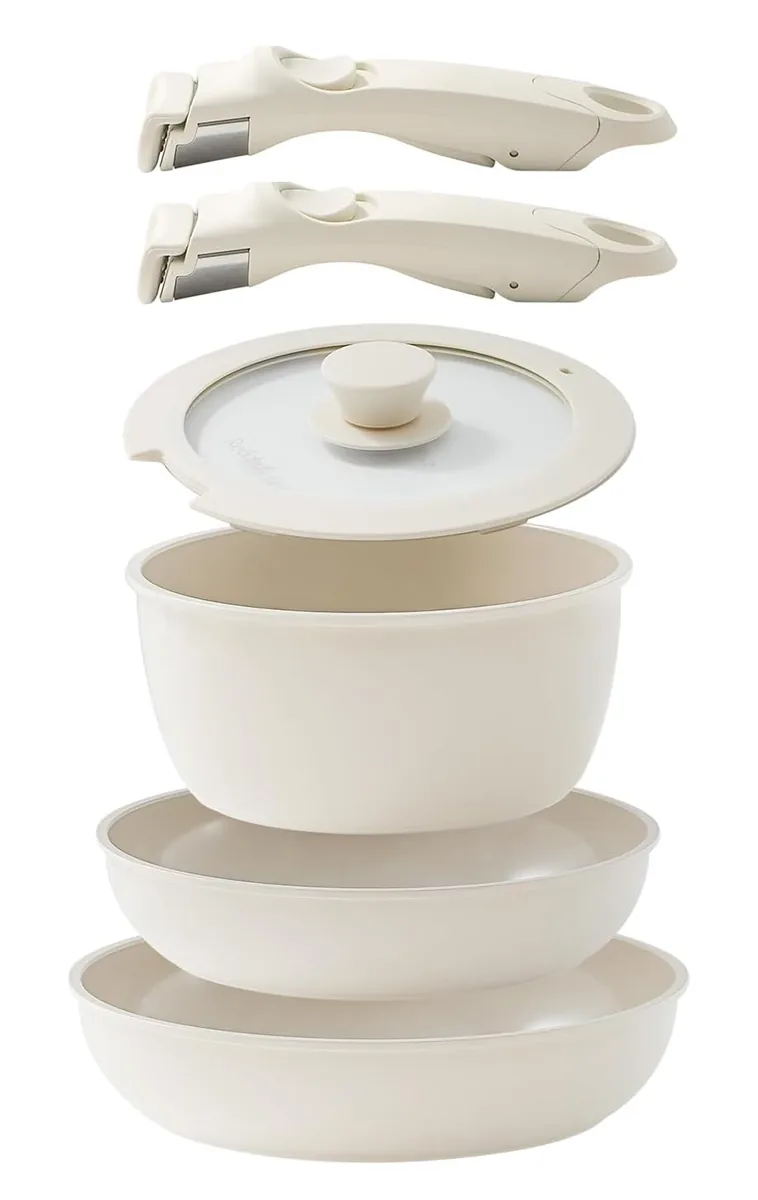
If you want a worked example of the same tradeoff at the set level, a detachable-handle set is the clearest one: what the handle buys you, and what it costs in coating life, are the same tradeoff, moved from one pan to the whole stack. Two companion pieces do the two follow-up questions — how the five Redchef set sizes differ is in the set size map, and how lids inflate a piece count is in the piece-count guide.
Heat: where ceramic quietly loses
Ceramic coatings have a temperature ceiling. Exceed it repeatedly and the coating degrades faster than normal use would explain. The problem is that this number is rarely printed on the box, and the ways people damage it are ordinary kitchen habits: preheating an empty pan on high, searing steak, finishing something under a broiler.
Stainless steel has no such ceiling in normal cooking. It can go from stovetop to oven to broiler, and a hard sear is exactly what it is built for. If high heat is part of how you cook, ceramic is the wrong tool regardless of price.
One more heat-related detail that matters for induction owners: clad stainless works on induction by design. Aluminum ceramic pans need a magnetic base layer to work at all, and listings are inconsistent about stating whether they have one.
Weight and handling
Aluminum is light, so ceramic nonstick pans are easy to lift, toss, and move between burners. A clad stainless skillet is noticeably heavier for the same diameter, partially because of the core and partially because the handles are built to be gripped with a towel. Neither is inherently better, but if wrist strain is a real constraint in your kitchen, it changes the calculation.
| Construction | Coated aluminum | Clad stainless with aluminum or copper core |
|---|---|---|
| Release | Built into the coating, degrades over time | Technique-dependent, never degrades |
| Typical lifespan | 1–3 years with daily use | 10+ years, often longer |
| High-heat cooking | Limited by the coating | High, within the pan’s own oven rating |
| Oven / broiler | Usually yes, within a temperature cap | Yes, including under the broiler |
| Metal utensils | No | Yes |
| Induction | Only with a magnetic base | Yes, on clad models |
| Repairable | No — coating cannot be reapplied | Yes — polish, reseason, re-rivet |
Cleaning and dishwasher reality
"Dishwasher safe" means the pan will survive the dishwasher, not that the dishwasher is good for it. For ceramic, detergent and long hot cycles accelerate the same degradation that high heat causes, so hand washing measurably extends the useful life. For stainless, the dishwasher is genuinely fine; the pan may come out spotted, and a powdered cleanser brings the shine back in about a minute.
The practical version: if you know you will always use the dishwasher, that is a quiet point in favour of stainless, even though both materials technically allow it.
Cost per year, not cost per set
This is the comparison almost nobody runs, and it is the one that settles the question. Take the purchase price, divide by the number of years you realistically keep the pan, and compare that number instead of the sticker price.
| Purchase | Realistic life | Annual cost, relative |
|---|---|---|
| Ceramic nonstick set | 2 years | Highest — replaced most often |
| Ceramic nonstick set | 3 years | High |
| Stainless clad set | 10 years | Low |
| Stainless clad set | 15 years | Lowest |
The pattern is consistent: ceramic looks cheaper at checkout and costs more per year, because you buy it again. That is not an argument against ceramic — it is an argument for knowing what you are buying. A cheap pan you replace twice is not a bargain if you thought you were buying it once.
Who should buy which
Choose ceramic nonstick if you cook eggs, fish, and vegetables at medium heat, want to use very little fat, and value a fast cleanup over longevity. Budget for replacement rather than resenting it.
Choose stainless steel if you sear, roast, deglaze, or cook with high heat, and if you would rather learn a technique once than replace a pan every other year.
A mixed kitchen is the honest answer for most people. One stainless skillet for heat and one ceramic pan for eggs covers nearly everything, and each material does the job the other is bad at. Buying two specialists is usually cheaper per year than buying one compromise.
Recommended products
If you are going ceramic, buy for the replacement clock
Given the two-year horizon, the sensible purchase is the smallest set that covers the cooking you do — not the largest stack on the page.
Smallest commitment
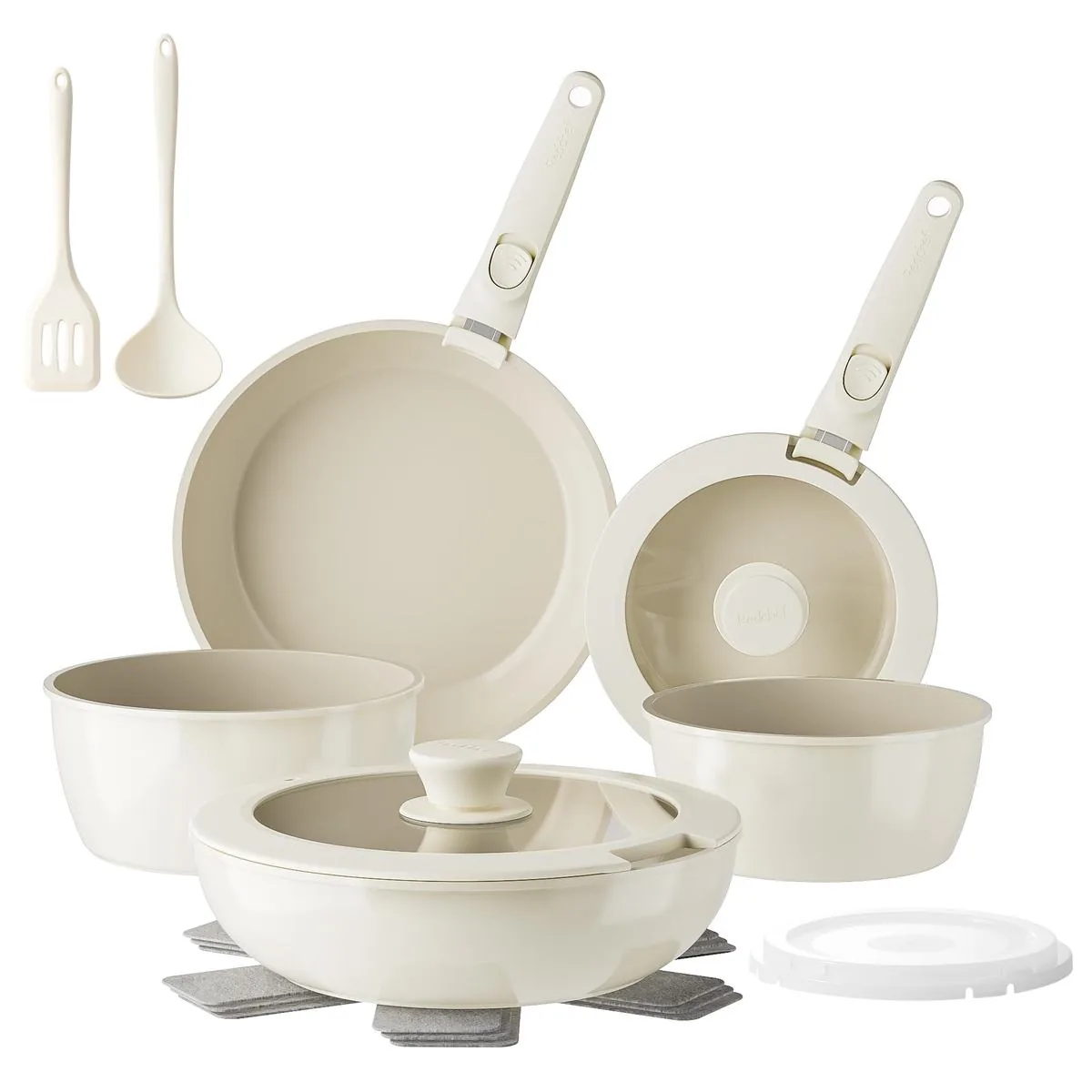
Redchef 5-piece ceramic set
Enough vessels for a two-person kitchen without paying for pans that will age unused in a cabinet.
Check current price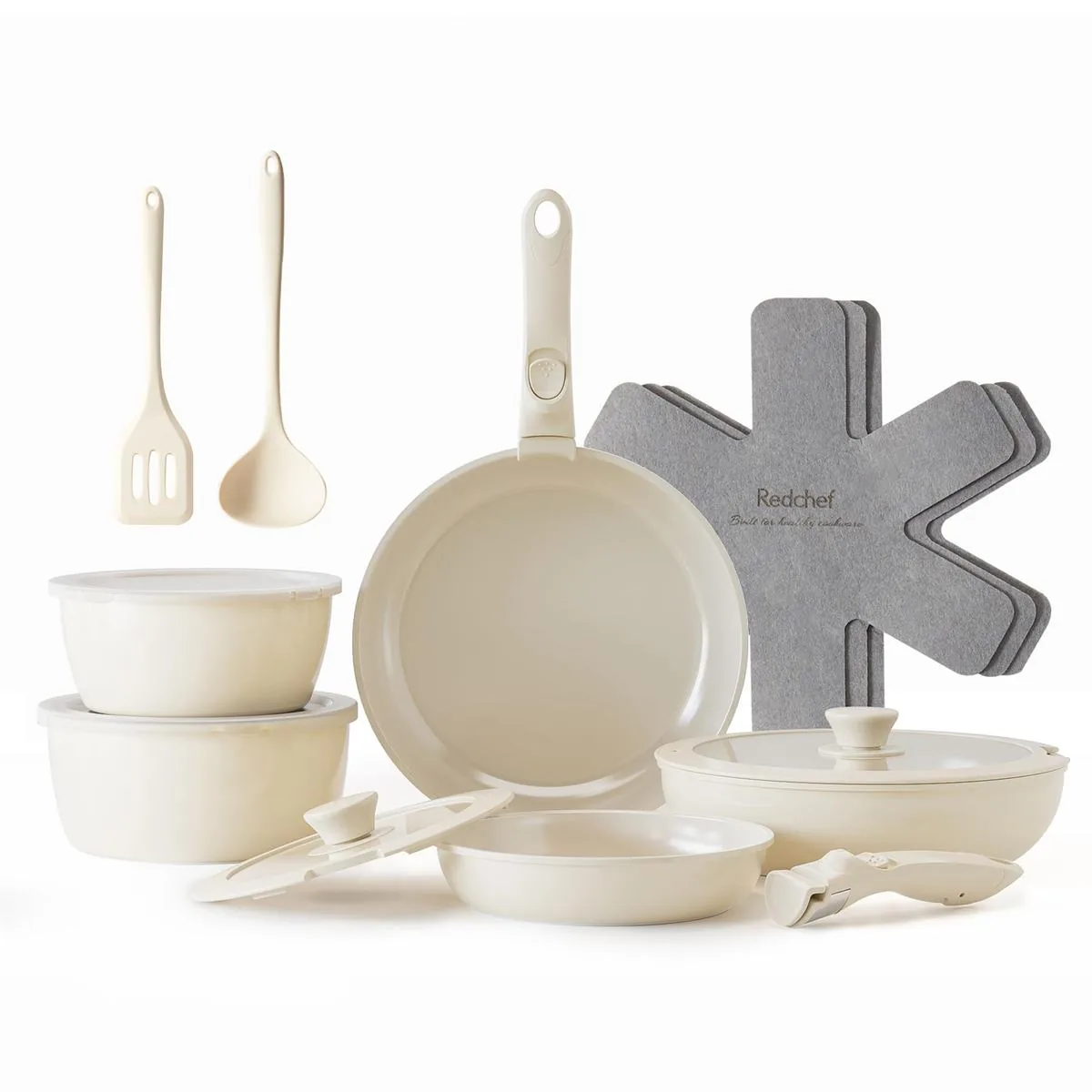
Currently unavailable
Redchef 16-piece set
This set was the reference behind our piece-count example. It is out of stock on Amazon as of November 2026, so the button below goes to the closest in-stock set in the same range.
See the 5-piece setAffiliate disclosure: We may earn a commission if you purchase through these links, at no additional cost to you.
Frequently asked questions
Is ceramic cookware safer than stainless steel?
Both are food-safe when used as directed, but the safety debates are about different things. Ceramic coatings are marketed as PTFE-free and PFOA-free, which addresses the fluoropolymer concern. Stainless steel can release trace nickel and chromium when acidic food sits in it for a long time, which regulators treat as within safe limits for normal cooking. The practical difference is that ceramic degrades mechanically — it stops releasing — while stainless stays inert.
How long does ceramic nonstick actually last?
One to three years with daily use is a realistic range. The coating cannot be restored, so the day eggs start sticking without added fat is the day the pan's useful life is over. High heat, metal utensils, and abrasive scrubbing shorten that timeline the fastest. The full breakdown — 12-month and 24-month owner reports, plus the three tests that tell you a coating is finished — is in how long ceramic nonstick lasts.
Is stainless steel really nonstick?
No, and that is the honest answer. Release comes from preheating, fat, and leaving food alone until it forms a crust. Once you have that technique, most foods release cleanly. Without it, eggs will weld to the pan, which is the experience most stainless skeptics are remembering.
Can I use metal utensils on stainless steel?
Yes. Bare stainless is not damaged by metal spatulas or tongs. Ceramic coatings should only see silicone, wood, or plastic, because a metal edge removes the coating permanently.
Sources
- Redchef 16-piece ceramic set — retail listing: PTFE-free ceramic coating, detachable handle, stacking design, oven and dishwasher wording, 4.5 stars across 1,328 ratings, checked November 2026
- Redchef 5-piece ceramic set — retail listing used for the lower-price half of the cost arithmetic, checked November 2026
How this comparison was researched
This article is built from manufacturer care instructions and maximum-temperature guidance, the material construction described in product listings, and owner complaints read at volume across both categories. The cost-per-year table is arithmetic on commonly listed prices, not a claim about any specific product. We did not run side-by-side lab tests, and we do not claim to have done so.