Small Appliances · Product profile
Casabrews 3700 Essential: Specs, Durability and Who It Fits
It is 6.5 inches wide, holds 43.9 oz of water in a tank you can carry to the sink, and pushes a 20-bar-rated pump. The specs are easy to summarize. The part that needs reading is what 4,469 owners disagree about: how long it lasts.
Affiliate disclosure: Some links on this page are affiliate links. If you buy through them, we may earn a commission at no extra cost to you.
Quick verdict
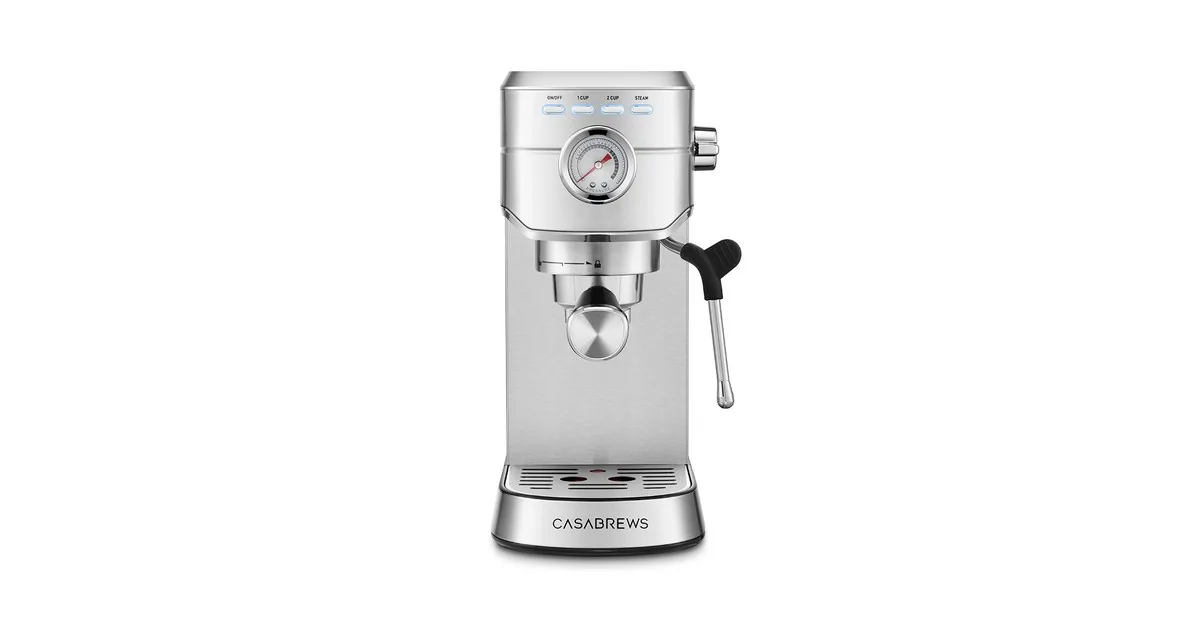
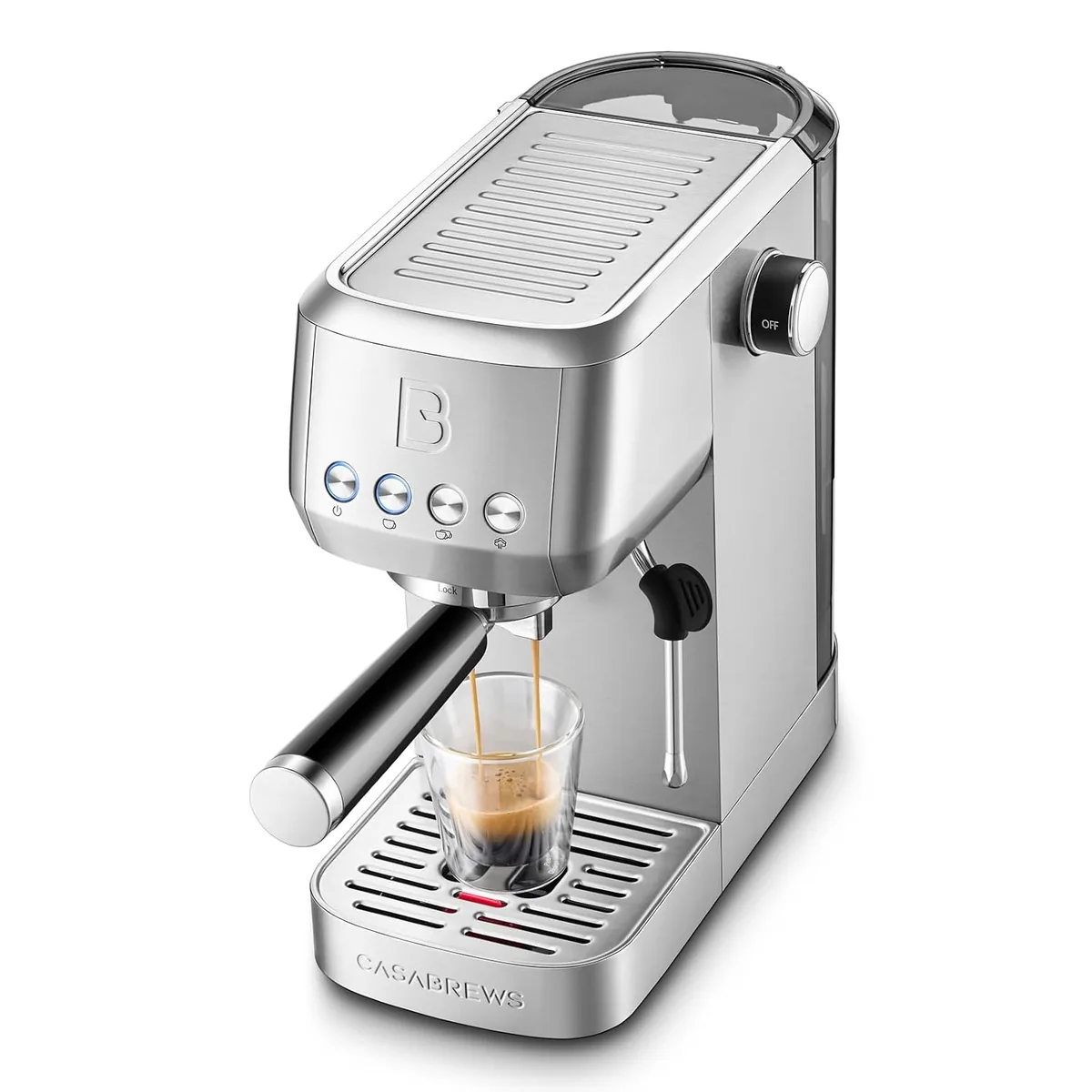
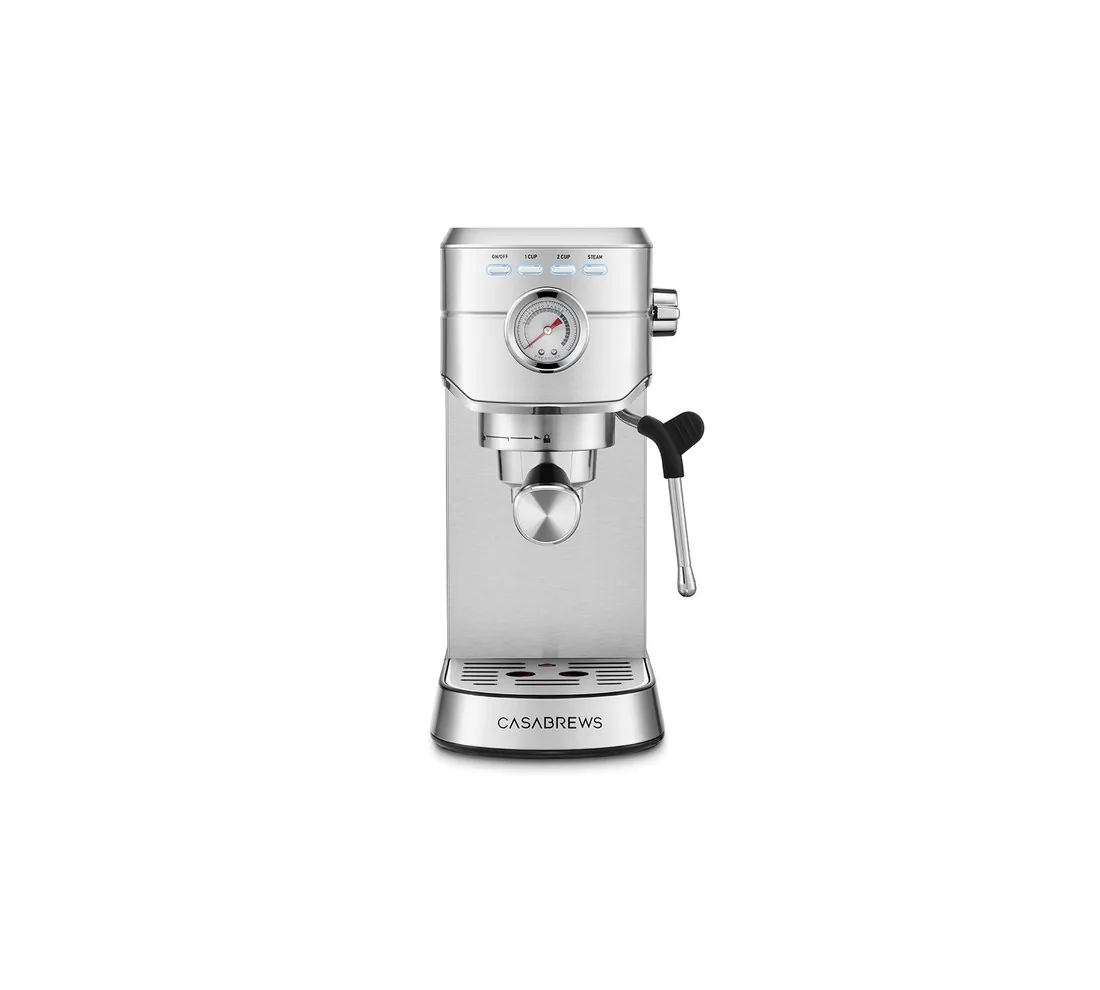
- What it is: a semi-automatic espresso machine with a 20-bar rated pump, a 1350 W heating element, a steam wand and a 43.9 oz removable water tank, in a body 6.5 inches wide.
- Best for: a counter with almost no spare width, one or two drinks a day, and a buyer who wants a stainless machine without paying for a grinder or a dual boiler.
- Skip it if: you want the grinder in the box, you need to pull shots while steaming, or you expect five years of service — the durability record is genuinely mixed.
- The owner signal: 4.3 / 5 across 4,469 ratings, 70 percent five-star against 9 percent one-star. Amazon's summary calls it well made for the price and compact, then flags heating elements failing inside a year for some owners.
Prices change daily — check the current price on the listing.
Check price at AmazonOpens the retailer's product page. Commission may be earned.
How this page was made: the specification table below is taken line by line from Casabrews' own retail listing and product imagery, both linked in Sources. The owner section quotes real review text from the listing and the rating distribution as it stood in November 2026. This is not a hands-on test: we did not measure pressure, temperature or steam time, and we publish no invented scores. Where Casabrews does not disclose a figure, we say “not published” instead of estimating. Read how we research for the full method.
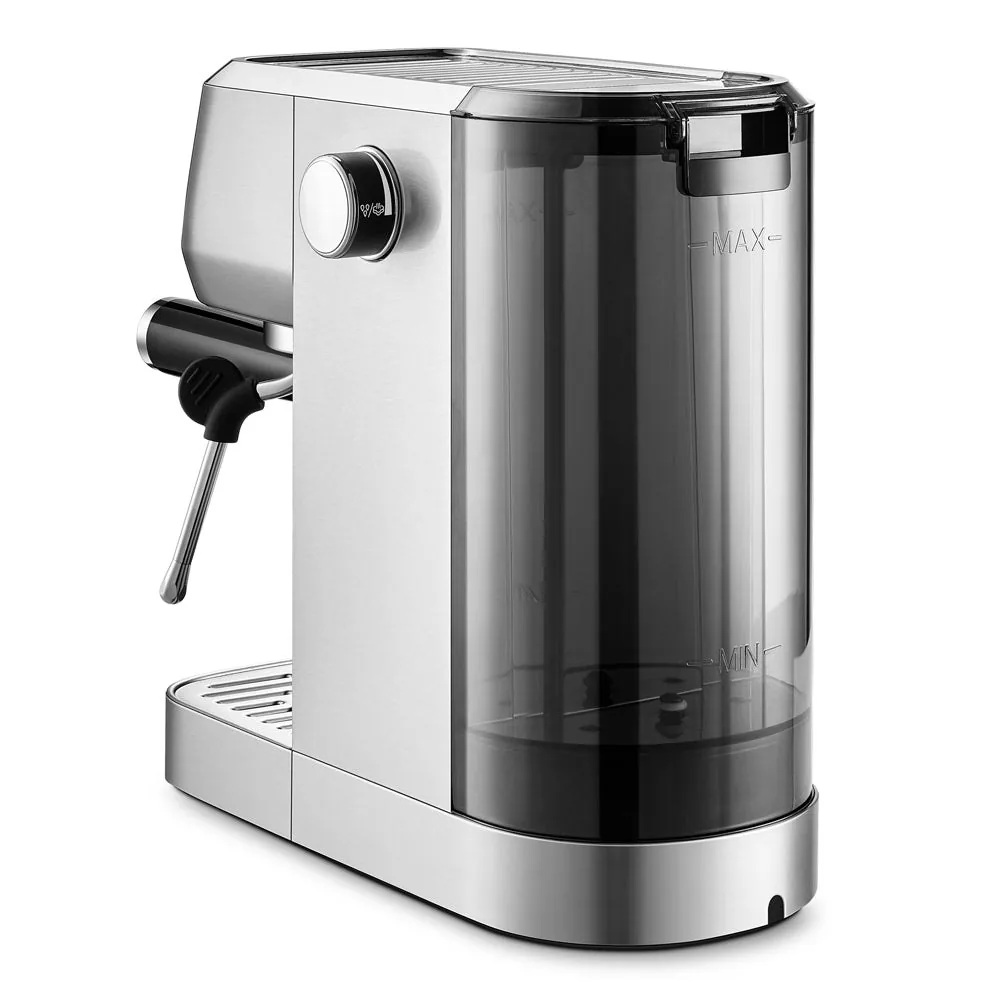
Manufacturer product image of the 3700 Essential from behind, showing the removable 43.9 oz tank and the MOUNT/UNMOUNT marks on the knob. This site has not photographed the machine. — Source: casabrews.com
At a glance
| Model | Casabrews 3700 Essential (stainless steel, A-Silver) |
|---|---|
| Type | Semi-automatic, 20-bar rated Italian pump; boiler type not stated on the listing |
| Heating element | 1350 W |
| Group head diameter | Not published |
| Steam | Steam wand ("powerful milk frothing system") |
| Water tank | 43.9 fl oz (about 1.3 L), removable |
| Drip tray | Removable, easy-clean |
| Cup warmer | Yes, built into the top plate |
| Pre-infusion | Yes, low-pressure pre-infusion before full brew |
| Weight | Not published |
| Dimensions | 13"D × 6.5"W × 12.1"H |
| Body | Stainless steel |
| In the box | Machine, water tank, one-cup and two-cup brewing filters, portafilter, tamper with measuring spoon, instruction manual |
| Price | Not listed here — prices change daily; the retailer link shows the current one |
What those numbers actually mean
6.5 inches wide. This is the reason to look at this machine at all. Most espresso machines in this band are around 11 to 13 inches wide, because the body has to wrap a boiler and a tank side by side. Casabrews moved the tank behind the group and kept the body narrow, so the 3700 fits on the sliver of counter between a fridge and a wall — a place where almost nothing else in the price band will go. Read the rest of this page as an argument about whether that one advantage is worth its compromises. If width is not your constraint, our under-$200 comparison has stronger machines on paper.
13 inches deep and 12.1 inches high. Depth is the spec people forget. A machine 13 inches front to back will not sit under a standard upper cabinet with a cup on the warming plate, so measure the clearance before anything else. The height matters for the same reason: with the cup warmer in use you need roughly 15 inches of clearance to slide a mug on and off.
43.9 oz (about 1.3 L) removable tank. Bigger than the 34 oz tank on the Gevi compact and worth having if two people drink from it. Removable is the detail that matters day to day: you carry it to the sink instead of pouring water into a machine you cannot move, and you can see the level without leaning over the group head.
1350 W. Normal for this class, and it sets the warm-up. Casabrews does not publish a warm-up time, so treat every "ready in seconds" claim — including the ones in reviews — as one owner's experience rather than a spec.
Low-pressure pre-infusion. The pump wets the puck gently before hitting full pressure. In practice it makes a coarse or uneven grind a little more forgiving, which matters because at this price most buyers start with pre-ground coffee. It is a real feature, not a marketing word, and Casabrews shows it in its own product imagery.
What is not published. The group head diameter and the machine weight are both missing from the listing. The group size is the one that costs you money later, because aftermarket baskets, tampers and bottomless portafilters are sold by diameter. If you plan to upgrade accessories, ask the seller which size it is before ordering — we will not guess it for you.
On the 20-bar figure
Espresso extracts at roughly 9 bar at the group head. A 20-bar rating describes how hard the pump can push, not what the puck sees. Every machine in this band prints 15 or 20 bar, and Casabrews itself frames the number as “consistent pressure for rich crema” rather than a fixed extraction pressure. Treat it as headroom. What actually helps you dial in a shot is feedback — a gauge, a bottomless portafilter, or a scale — and this machine does not ship with a gauge. That is the same trade-off we describe in the four specs that decide an espresso machine.
One drink at a time
The listing never says how many boilers the 3700 has, so we will not assert it. What we can report is what an owner says: a reviewer who used to work at a commercial coffee company describes the machine as a single boiler and notes you may “wait a few seconds when switching between brewing and steaming.” His framing is the honest one — the seconds are the price of not spending several hundred dollars more.
For a household making one latte each in the morning, that pause is invisible. For two people who both want milk at the same moment, it becomes a queue. If that is your routine, a machine with a separate steam circuit — such as the Gevi dual boiler — solves it and costs a lot more.
What 4,469 ratings say — and where they split
The listing averages 4.3 / 5 across 4,469 ratings, distributed 70 percent five-star, 12 percent four-star, 5 percent three-star, 4 percent two-star and 9 percent one-star. That shape — a big block of satisfaction and a stubborn 9 percent at the bottom — is typical of a cheap machine that works well until it does not.
Amazon's own summary of the reviews is unusually direct about the split. It reports that owners like the stainless design, find it compact and well worth the money, and describe the coffee as good, if not on the level of a proper cafe shot. Then it says plainly that while some owners report the machine holding up over time, others report heating elements breaking within a year of use. That is the sentence to weigh before buying, not the 4.3 average.
The topic counts under "Select to learn more" show where owner attention goes: performance leads by a wide margin (about 1K mentions), then value for money (520), espresso quality (408) and durability (171). Durability is only the fourth-largest topic, but it is the one that decides whether the purchase was cheap or expensive.
The review text fills in both sides. A five-star reviewer who bought in February 2024 and wrote in August 2026 — more than two years later — reports the machine still heats quickly, holds pressure, and looks new, and credits regular descaling and keeping the steam wand clean. A three-star reviewer titled “Loved it for 2 years” describes the opposite ending: the frother nozzle clogged earlier in ownership, then the machine stopped mid-cup, all the lights flashed, and it would not reset. Same price, same machine, two different outcomes. That is what a 9 percent one-star block looks like from the inside.
Two smaller details surface in the reviews and are worth knowing. First, the included tamper is weak: one five-star owner says it “didn't work great” and bought a replacement, which is a few dollars and no reason to reject the machine. Second, pre-warming helps — an owner recommends running water through an empty basket into a cup before pulling the first shot, so the espresso lands in a warm cup at the right temperature.
Pros
- 6.5 in wide — the narrowest footprint in this price band that we have checked
- 43.9 oz removable tank, easy to carry and easy to see the level
- Low-pressure pre-infusion, which forgives an uneven grind
- Built-in cup warmer and a removable drip tray
- Stainless steel body that owners consistently describe as looking better than the price
- 4,469 ratings, so the failure reports are a pattern rather than a rumour
Cons
- Heating elements failing inside a year for a minority of owners
- No pressure gauge, so you have less feedback while dialling in
- Group head diameter not published — check before buying accessories
- No grinder; pre-ground coffee or a separate burr grinder
- One boiler by owner report, so brewing and steaming do not overlap
- Included tamper is the weakest item in the box
Who should buy it
| A narrow counter, 6.5 in of space | Yes — this is the machine's whole argument. Nothing else here is this narrow. |
|---|---|
| One or two drinks a day, one at a time | Yes. The boiler limitation never surfaces. |
| Two people wanting milk drinks simultaneously | No. Expect a queue; a dual-boiler machine is the answer. |
| You want a grinder included | No. See the Gevi with built-in grinder, or a separate burr grinder. |
| You plan to own it for five years | Risky. Read the newest one-star reviews first; there is a real failure record here. |
| You want a gauge to learn on | No gauge here. The Gevi compact has one for a similar outlay. |
Where it sits next to the machine we already covered
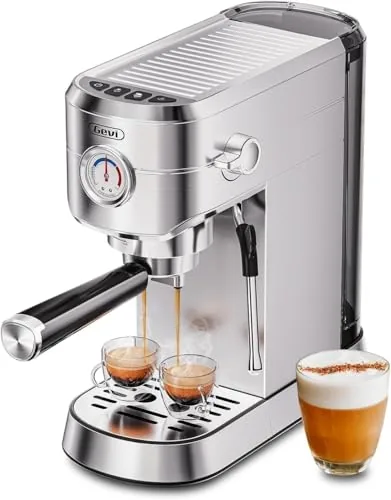
The obvious comparison is the Gevi compact, and the honest summary is that each wins one column. Casabrews wins width by more than an inch and a half, tank size by about 10 oz, and — on the listing's own evidence — a slightly better build feel. Gevi wins on documented specifications: it publishes its group head size, its weight and its temperature control, and it ships with a pressure gauge. If you are choosing between the two, the full side-by-side is in Gevi compact vs Casabrews 3700; if width is your binding constraint, this page answers your question and the comparison does not need to.
Bottom line
The 3700 Essential is a narrow, stainless, pre-infusing machine with a large removable tank and a 4.3 average across a genuinely large owner base. It is not the best-specified espresso machine under $200 — the missing gauge, the unpublished group size and the mixed durability record all cost it points. It is, however, the one that fits in 6.5 inches, and that is a real constraint for real kitchens. Buy it for the footprint and the tank, keep up with descaling, and read the one-star reviews so you know what you are accepting.
Check current price · Manufacturer page
Frequently asked questions
How wide is it, really?
The listing publishes 13"D × 6.5"W × 12.1"H. The 6.5 inches is the body width; leave a little clearance on each side so you can turn the steam wand.
Does it come with a grinder?
No. Machine, tank, two filter baskets, portafilter, tamper with spoon, manual. A burr grinder is a separate purchase.
Can it brew and steam at the same time?
The boiler type is not published. An owner with commercial coffee experience describes it as a single boiler with a wait of a few seconds between brewing and steaming. Plan on sequential drinks.
How long do owners say it lasts?
It splits. Amazon's review summary reports some units holding up well over time and others with heating elements failing inside a year; one three-star review describes the machine stopping after almost exactly two years and refusing to reset.
What portafilter size is it?
Not published. If you want aftermarket baskets or a bottomless portafilter, confirm the diameter with the seller first rather than assuming 51 or 58 mm.
Do I need to pre-warm the cup?
Owners recommend it: run water through an empty basket into your cup before the shot. It costs a few seconds and stops a good shot landing in a cold cup. The top plate also works as a cup warmer once the machine is hot.
Did you test it hands-on?
No. Published specs plus owner ratings and review text, with the method written out. See how we research.
Sources
- Retail listing — specification table, in-box contents, rating count, rating distribution, review summary and review text, checked November 2026
- Casabrews: 3700 Essential product page
- Casabrews: brand site — model range and accessory list
How this review was researched
This is a research-based profile, not a hands-on test. Specifications come from the manufacturer's retail listing and product imagery; owner reaction is taken from the rating count, rating distribution, review summary and individual review text on the live listing. We did not run instrumented measurements and we publish no invented scores. Where the manufacturer does not disclose a figure — the group head diameter and the machine weight on this model — we say so rather than estimate it. Prices and availability change without notice; confirm on the listing before buying.
Keep reading