Cookware
Redchef's Ceramic Sets: Five Sizes, and None of the Titles Say What Is Inside
A 3-piece, a 6-piece, a 14-piece, a 16-piece and a three-pan frying set. The piece counts are not comparable, the lids are not included everywhere, and the coating is the part that decides how long any of them lasts.
Affiliate disclosure: Some links on this page are affiliate links. If you buy through them, we may earn a commission at no extra cost to you.
Prices change daily — check the current price on the listing.
See the five-piece set at AmazonOpens the retailer's product page. Commission may be earned.
Redchef sells ceramic cookware under five different set names, and the listing titles are the worst possible guide to what you get. "3 pieces" counts a frying pan, a saucepan and its lid as three. "6 pieces" counts three pots and three lids. "16 pieces" counts a stack of pans that share one removable handle. Buy the wrong one and you end up with either four lids you never use or a frying pan with nothing to cover it.
This page maps every set against what it actually holds, what each size can cook, and the one thing that decides whether the purchase ages well: the ceramic layer, which is a coating rather than a metal surface. All figures below come from the retail listings and from owner reviews read on November 11, 2026. No price is quoted, because they move daily.
The five set names, decoded
The brand's own comparison table lists five sets. The piece counts jump around because the mixes are different, not because the sizes grow in a straight line.
| Set | Pieces | What is actually inside | Ratings on the listing |
|---|---|---|---|
| 3-piece set | 3 | 8-inch frying pan, 2.5-quart saucepan, one glass lid | 4.6 stars across 137 ratings |
| 6-piece line | 6 | 2.5-quart, 3.5-quart and 5-quart pots, each with a lid | 137 ratings on the same listing family |
| 14-piece set | 14 | 9.5-inch and 11-inch frying pans plus the pot sizes, with lids | 255 ratings |
| 16-piece set | 16 | Pots and pans sharing one detachable handle | 4.5 stars across 1,328 ratings |
| Frying pan set | 3 | 8, 9.5 and 11-inch frying pans, no lids | 4.2 stars across 1,675 ratings |
The number that matters is not the piece count. It is how many pans you actually cook in and how many of them can carry a lid. A 6-piece line gives you three cookable vessels. A 3-piece set gives you two. The frying set gives you three cookable pieces and zero lids.
Comparing the in-stock sets side by side on one listing page is the fastest way to see the lid gap.
Check the 5-piece listingWhat each pan size can actually do
8-inch frying pan
One or two eggs, a single grilled sandwich, a small amount of sausage. The 8-inch is the least useful pan in a set and the one that ends up stacked on top of everything else. In owner reviews it is described as a one-person pan, which is accurate: it holds a single serving without crowding.
9.5-inch frying pan
The everyday size. Two eggs without touching, three pancakes, a stir-fry for two. Owner reports describe using the 9.5 and 11 for eggs, omelets, pancakes and quick stir-fries, and calling the pair "perfect for everyday cooking". If you cook for two people most nights, this is the pan that gets the wear.
11-inch frying pan
Family portions, searing, and the pan that gets flipped least. It is also the one where the missing lid hurts most: an 11-inch pan with a universal lid is where owners report liquid landing on the cooktop because the cover does not seat.
2.5-quart saucepan
One to two servings of sauce, a can of soup, pasta for two, oatmeal. Redchef describes it as space-saving and sized for one or two. This is the smallest pot that still earns cabinet space.
3.5-quart and 5-quart pots
Rice and grains in the 3.5; soups, stews, boiling pasta for a family, and batch cooking in the 5. An owner running the 6-piece line called the 5-quart large enough for "an entire meal in that for the whole house", which matches what the size is for.
4-quart sauté pan (separate listing)
The 11-inch deep pan with a lid is sold on its own rather than as part of a set. It is the one piece that covers sauteing, braising, steaming and one-pan meals, and it is the only Redchef piece whose listing describes the glass lid as useful for monitoring without losing moisture. If you cook stews and braises, this shape does more work than any frying pan in the sets.
The part that decides how long you keep it
Every Redchef line uses the same construction: a forged aluminum body, a triple-layer ceramic coating described as mineral-based and free of PFAS, PTFE, PFOA, lead and cadmium, and a stainless steel handle with double rivets. The aluminum is why the pans are light and heat evenly. The ceramic is why they release food without oil. And the ceramic is the part with a service life.
That is not a marketing caveat, it is what owners describe. A reviewer with rental properties wrote that she was on her fourth set, that the first set had been used daily at home for about two years and had stained and stopped being non-stick, while pans from the same order used less often still worked. She drew the honest conclusion: they do not last forever, and the price reflects that.
Two other failure modes show up in reviews more than once:
- Rim chipping from stacking. A reviewer who otherwise rated the pans highly warned about stacking them directly on top of each other, and noticed small chips around the rims where pans had been piled. Use a towel or a paper plate between pans, or nest them with the smallest inside the largest.
- Utensil damage. The same reviewer used only wood on purpose. Listings mention metal-utensil tolerance; a ceramic layer is a thin mineral coating over metal, so any hardened edge is a risk. Silicone and wood cost nothing to switch to.
None of this is unique to Redchef. It is the physics of a ceramic layer: it is not welded to the metal, it sits on top of it, and anything abrasive works on it. The question is not whether the coating wears, it is whether the pans around it are shaped well enough to be worth re-buying. See the materials comparison for why stainless has no such expiry date and pays for it in heat response.
Induction, oven and dishwasher: the three claims worth checking
Induction. Redchef lists induction, gas, electric coil and smooth-top compatibility across all five sets. Owners confirm the behavior on real stoves, including one who tested the pans on an induction cooktop and reported the pans heat evenly and hold the setting. A second owner said the pans work on a conduction stove as well. The practical limit is base flatness: a warped pan on induction couples badly, so avoid plunging a hot pan into cold water.
Oven. The listings give 842 degrees Fahrenheit as the oven maximum and mark broiler safe. Note what the same listings say about glass: the lid is excluded from oven use, and the 3-piece set spells it out as a parenthetical. Take lids off before baking, and remember that a stainless handle can take the heat but will be hot.
Dishwasher. Every set is marked dishwasher safe. The brand's care note still recommends hand washing to extend the coating's life, and one owner admitted she had not put her pots through the dishwasher and could not say how they would come out. Two other complaints worth knowing: lid knobs get hot enough to need a pot holder, and the pans are light enough that a heavy-handed stir can slide them on a smooth cooktop.
Burner size, storage, and the handle question
An 11-inch pan on a small burner is the mismatch nobody mentions
Cookware sizes are quoted as pan diameter, but what decides whether a pan cooks well is the ring of flame or the induction coil underneath it. On a typical apartment range with one large burner and three smaller ones, an 11-inch pan only behaves on the large burner: put it over an 8-inch coil and the outer third of the pan stays cool, which is exactly where a stir-fry needs heat. The 9.5-inch pan covers a medium burner properly, and the 8-inch is the one that will fit a simmer burner without hanging over the edge.
This is the argument for the 3-piece and 6-piece mixes rather than the widest set. Three pans that each match a burner you actually have beat five pans where two are sized for a range you do not. Measure your largest burner diameter before you choose, and treat that number as the ceiling for the pans you will use daily.
Storage is the constraint that decides the 16-piece set
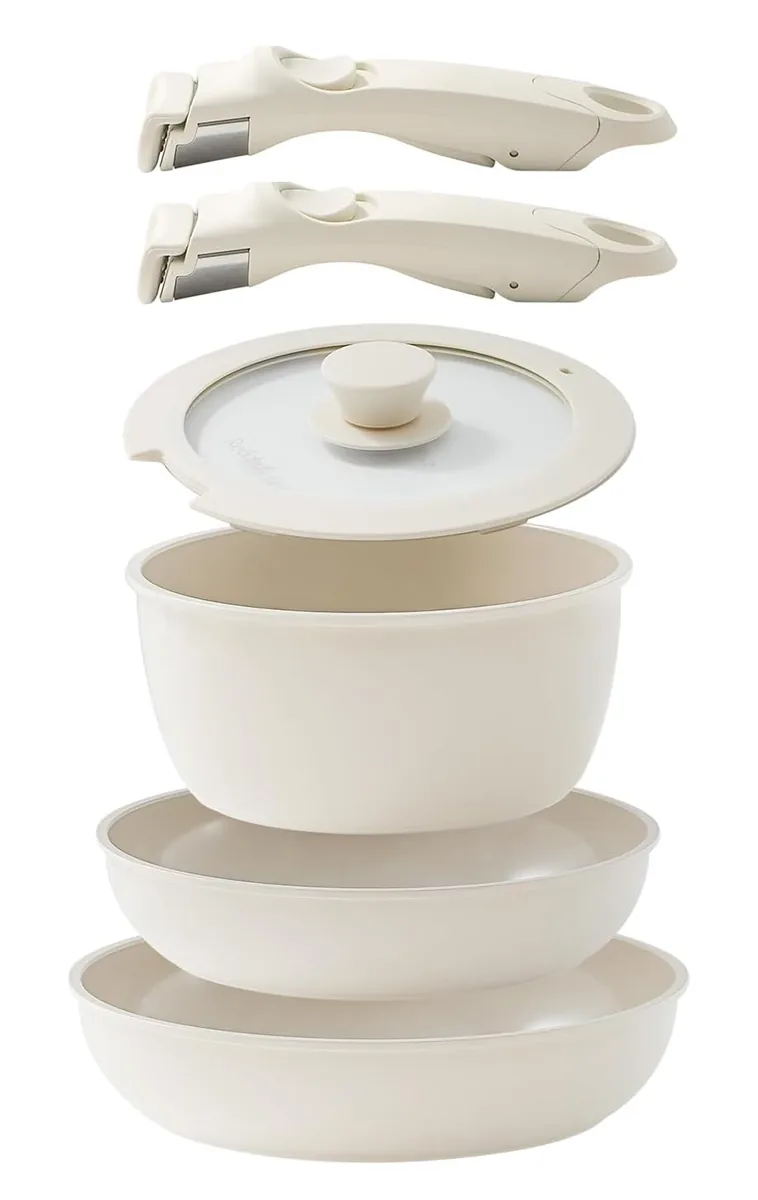
The 16-piece set is the only Redchef line that solves stacking with hardware instead of with cabinet space: the pans and pots share one removable handle, so the bodies nest with nothing sticking out. In a small kitchen this is the difference between a stack that fits under a counter and one that does not. The listing weight is around 10.4 pounds for the whole set, which is light for sixteen pieces precisely because the handles are not duplicated.
The cost of that design is a step in every recipe. A pan that needs to move from cooktop to oven to serving has to be re-handled, and a handle that has just come off a hot pan is the part you must not grab bare-handed. Owners of detachable-handle sets consistently describe two habits that make it work: keep the handle clipped to the pan you are using rather than stored separately, and use the supplied silicone grip or a folded towel when swapping mid-cook. If you cook one-pan meals and rarely move a pan into the oven, a fixed-handle line is simpler. Buy the detachable handle only when storage is the constraint you are actually solving.
What the low ratings say
The frying pan set carries the largest sample and the lowest average: 4.2 stars across 1,675 ratings, with 69 percent at five stars and a 10 percent one-star tail. That tail is unusually large for cookware and worth reading rather than dismissing.
The three recurring complaints in that group:
- Sticking after a while. Buyers who liked the pans at month one report food beginning to stick later, which lines up with the two-year coating life described above.
- Chipping and scratching. Some buyers report the surface chipping within a few uses; others report it holding up. This is the split that shows up in the listing's own summary of reviews.
- Value disagreement. The listing's review summary notes value opinions divided between buyers who think the set is excellent for the money and buyers who think it is not worth it. Both are describing the same product at different points in its life.
What buyers consistently praise is the part that does not wear: the pans heat evenly on flat glass tops, clean up easily, and look good. The handles stay cool during cooking, which is a real differentiator against cheap sets where the handle is the first thing to fail.
What real owners say
The Redchef lineup spans three main configurations, and their Amazon ratings tell different stories:
The 16-piece set is the flagship: 4.5 stars across 1,328 ratings, with 77 percent five-star reviews. Owners love the detachable handles for RV storage and small kitchens, and the full enamel coating (including the bottom) stands up to 850°F stovetop heat — roughly double the tolerance of competing nonstick sets.
The 5-piece set is the quiet best-seller: 4.5 stars across 3,267 ratings, making it the highest-reviewed product in the lineup. Owners consistently mention the stackable, space-saving design and that the nonstick surface holds up better than expected for the price. The recurring complaint is that the handle attachment mechanism can occasionally get stuck, and a few owners note it is not dishwasher-safe despite the marketing language.
The three-pan frying set (8, 9.5, and 11 inches) has the weakest rating: 4.2 stars across 1,675 ratings, with a notable 10 percent one-star share. The complaints cluster around one issue: owners reporting the coating losing release after two to three months of daily use, with food beginning to stick. Several owners note that the set does not include lids, which is a disadvantage if you expected to cover the pans.
In short: the 16-piece and 5-piece configurations are well-regarded, while the standalone frying-pan set has the most durability complaints.
Which set to buy
| If this is you | Buy | Why |
|---|---|---|
| One or two people, eggs and quick meals | The 3-piece set | Two cookable pieces with a lid on the pot; nothing you will not use |
| Cooking for two, some rice and pasta | The 6-piece line | Three pot sizes, all with lids, plus the frying pans you add separately |
| Family cooking, want to replace the whole cabinet | The 14-piece set | Adds 9.5 and 11-inch pans to the pot sizes; the widest coverage |
| Small kitchen, storage is the real constraint | The 5-piece set with the detachable handle | Same one-handle stacking in a smaller stack; the 16-piece version is out of stock as of November 2026 |
| You already have pots and need pans only | The three-pan frying set | Cheapest route to the three most-used sizes, but no lids |
Two cautions before you commit. First, if lid coverage matters, buy a line that includes it; a universal lid on a 9.5-inch pan is where owners report leaks. Second, plan for the coating's two-year horizon in your head before you buy, not after. If you want a pan you keep for a decade, ceramic is the wrong material, and the detachable-handle versions are where that trade-off is most visible.
The piece count is a packaging decision. The coating life is the purchase decision.
Recommended products
The two sizes most people should compare
The 5-piece set is the low-commitment way to test the coating before you replace a cabinet. The 16-piece stack covers the widest range of cooking with one handle, but it is out of stock as of November 2026.
Lowest commitment
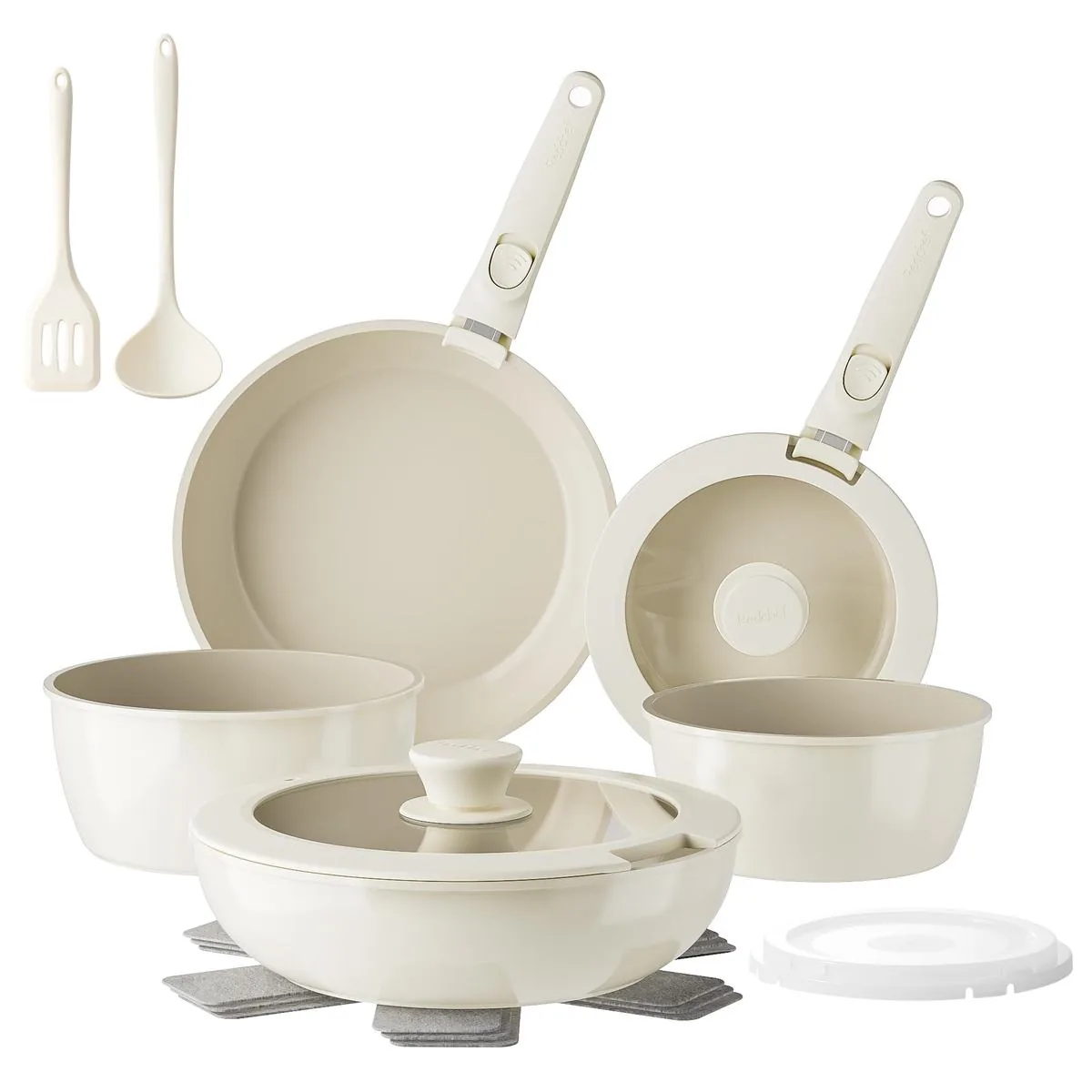
Redchef 5-piece ceramic set
The smallest way into the same coating. Right for a first flat with two burners, or for testing whether a ceramic surface suits how you cook.
Check current price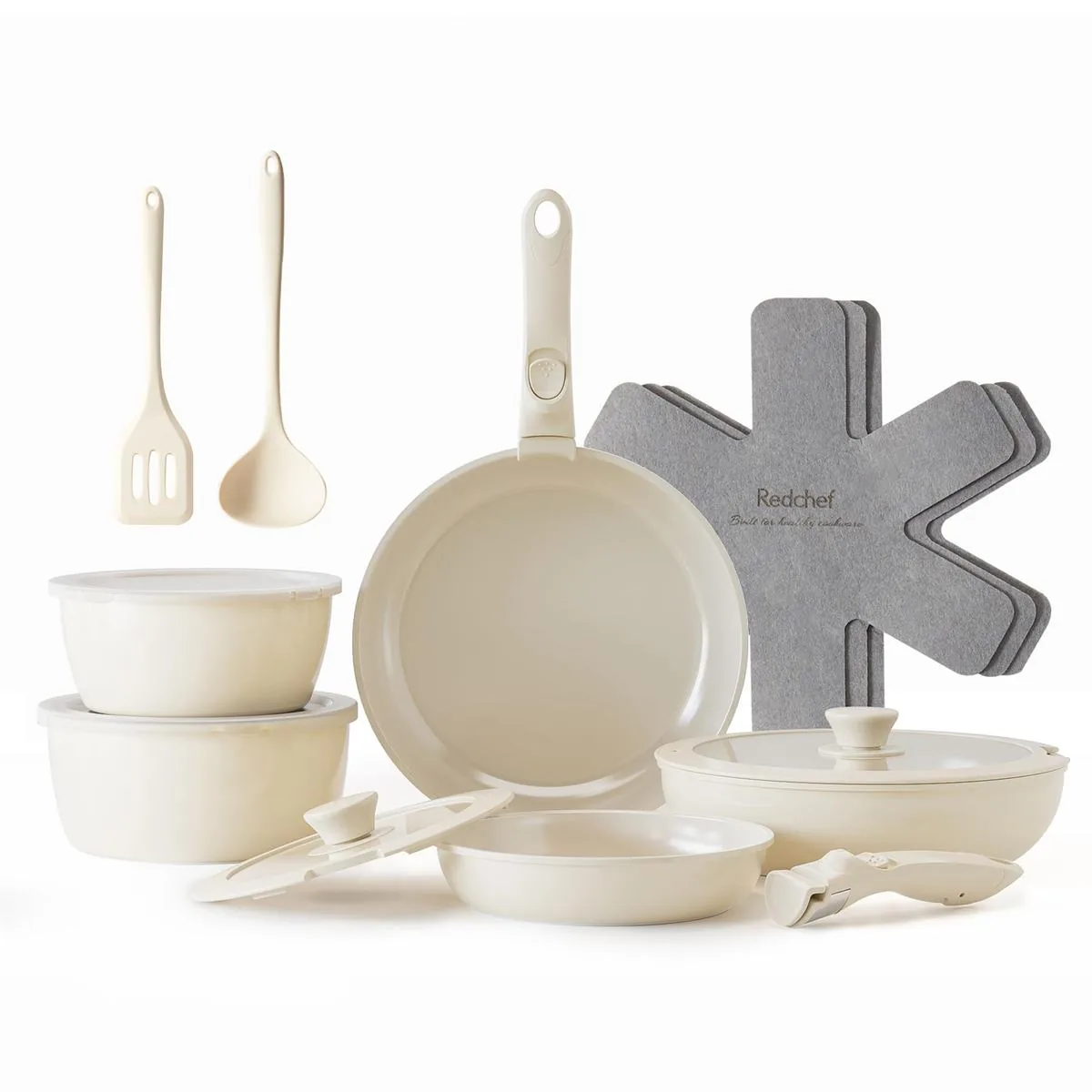
Currently unavailable
Redchef 16-piece set
This set was the reference behind our piece-count example. It is out of stock on Amazon as of November 2026, so the button below goes to the closest in-stock set in the same range.
See the 5-piece setAffiliate disclosure: We may earn a commission if you purchase through these links, at no additional cost to you.
Where this leads
Two follow-ups worth reading before you choose a size. If the question behind the question is whether a coating is the right material at all, the honest answer is in how long ceramic nonstick lasts — two years of daily use is the number to plan with, and none of these sets is built to last a decade. If you are comparing these counts against sets from other brands, the counting rules that make six pieces into three pots are explained in what a piece count actually buys.
Frequently asked questions
How many pieces are in each Redchef ceramic set?
The five productions break down as: a three-piece set with an 8-inch frying pan and a 2.5-quart saucepan with lid; a six-piece line built from 2.5, 3.5 and 5-quart pots; a 14-piece line that adds 9.5-inch and 11-inch pans to the pot sizes; a 16-piece set with a detachable handle; and a three-pan frying set in 8, 9.5 and 11 inches. Piece counts include lids and shared handles, so two sets with the same count can hold different cooking capacity.
Do all Redchef sets work on induction?
Redchef publishes induction compatibility across its ceramic lines, along with gas, electric coil and smooth-top electric. The brand's own comparison table lists induction as supported on all five sets. Induction performance still depends on the base flatness, so a pan that has been warped by a fast cool-down is the one that stops coupling properly.
Are the glass lids oven safe?
No. Redchef lists the pans as oven safe to 842 degrees Fahrenheit and states separately that the glass lid is excluded from oven use. On listings that mention the lid in the oven-safe claim, the lid section itself carries the note. Take the lid off before broiling or baking.
Does the frying pan set come with lids?
The three-pan frying set in 8, 9.5 and 11 inches ships without lids, which owners raise repeatedly. One reviewer measured the gap in practice: a universal lid did not seal on the smaller pan and liquid ran onto the stove. If lid coverage matters, buy a line that includes it rather than adding lids later.
How long does the ceramic coating last?
Owner reports put daily-use life at roughly two years for the most-used pan before the surface stains and stops releasing food. A reviewer running these pans in rental units said the first set lost its non-stick behavior after two years of daily use, while lower-use pans in the same order still worked. Ceramic coating is a consumable layer, not a metal surface.
Can these pans go in the dishwasher if the coating is fragile?
The listings say dishwasher safe, and the brand's own care note recommends hand washing to extend coating life. Harsh detergent and the heat of a drying cycle attack the same layer that provides release. Hand washing with a soft sponge is the lower-risk habit; the dishwasher is the convenience option, not the maintenance plan.
Sources
- Retail listing — 16-piece set, rating count and family comparison table, checked November 11, 2026; the set is currently unavailable on Amazon
- Retail listing — 5-piece set, checked November 11, 2026
- Manufacturer listing pages for the 3-piece, 6-piece, 14-piece, 16-piece and three-pan frying set: piece contents, coating description, oven maximum, induction compatibility, item weights and best-seller ranks, read November 11, 2026
- Owner reviews quoted from the frying set and 6-piece listings, including the two-year daily-use report and the stacking-chip warning, read November 11, 2026
How this page was researched
This is a research-based comparison, not a hands-on test. We have not bought or used these pans. Piece contents, coating specification, oven and cooktop compatibility come from the manufacturer's published listings and comparison table; durability and failure reports are summarized from owner reviews on the retail listings. We do not publish invented scores. Prices and availability change without notice — confirm on the listing before buying.
Keep reading