Small Appliances · Product profile
Gevi 20 Bar Compact Espresso Machine: Specs and Who It Fits
The spec sheet is unusually complete for this price: a 51 mm group head, PID control, a working pressure gauge, a 34 oz tank, and a body 5.5 inches wide. This page reads those numbers back to you in plain terms, then says who should skip the machine.
Affiliate disclosure: Some links on this page are affiliate links. If you buy through them, we may earn a commission at no extra cost to you.
Quick verdict
- What it is: a semi-automatic single-boiler espresso machine with a 20-bar rated pump, PID temperature control, a 51 mm portafilter and a pressure gauge.
- Best for: one or two drinks a day, a counter that cannot take a 12-inch footprint, and a buyer who would rather learn to steam milk than have it automated.
- Skip it if: you make several milk drinks back to back, or you want the grinder included — the single-boiler design is the limit here, not the price.
- The owner signal: 4.3 / 5 across 3,814 ratings, with 70 percent five-star and 7 percent one-star. Amazon's review summary flags two recurring complaints: build or leak failures (117 mentions) and a portafilter handle that is awkward to lock (82 mentions).
Prices change daily — check the current price on the listing.
Check price at AmazonOpens the retailer's product page. Commission may be earned.
How this page was made: every specification below is taken from Gevi's own product page and range comparison table plus the retail listing, all linked in Sources. Owner reaction is summarized from the rating count and average on the live retail listing. This is not a hands-on test: we did not measure pressure, temperature stability or steam time, and we do not publish invented scores. Read how we research for the full method.
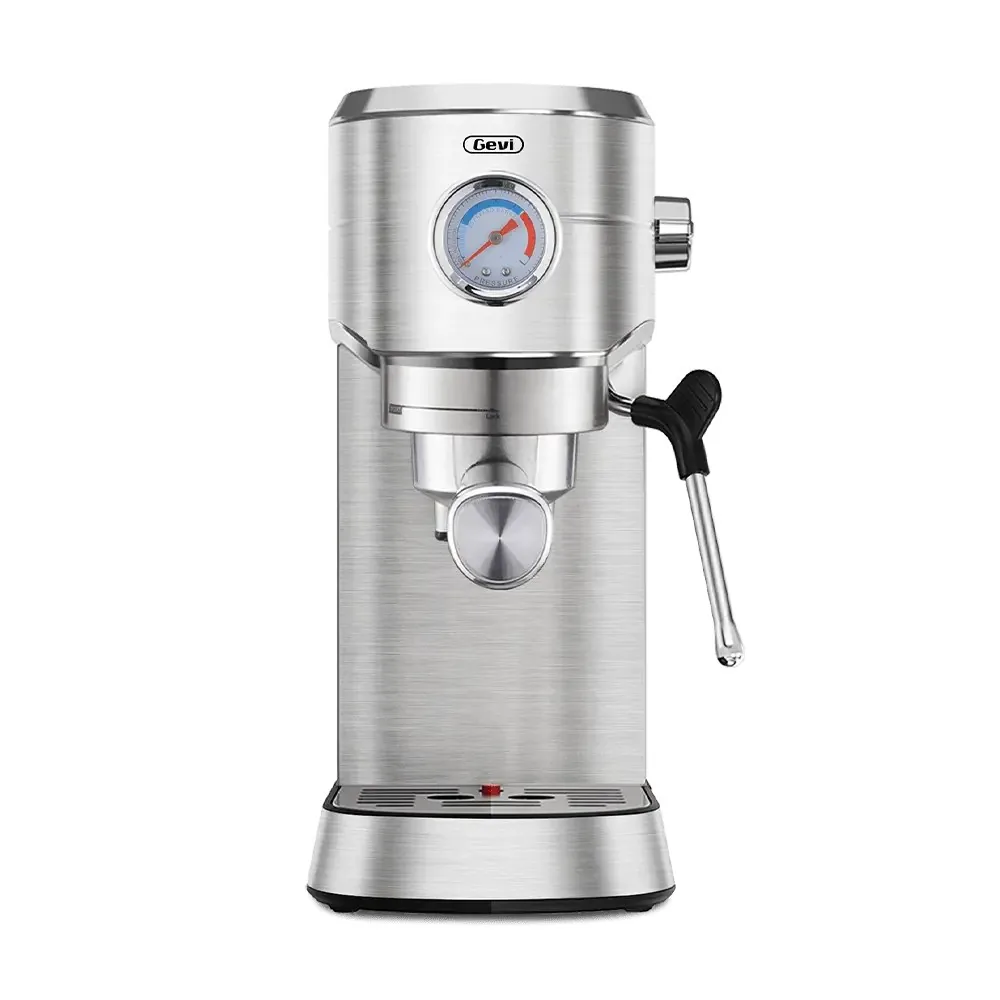
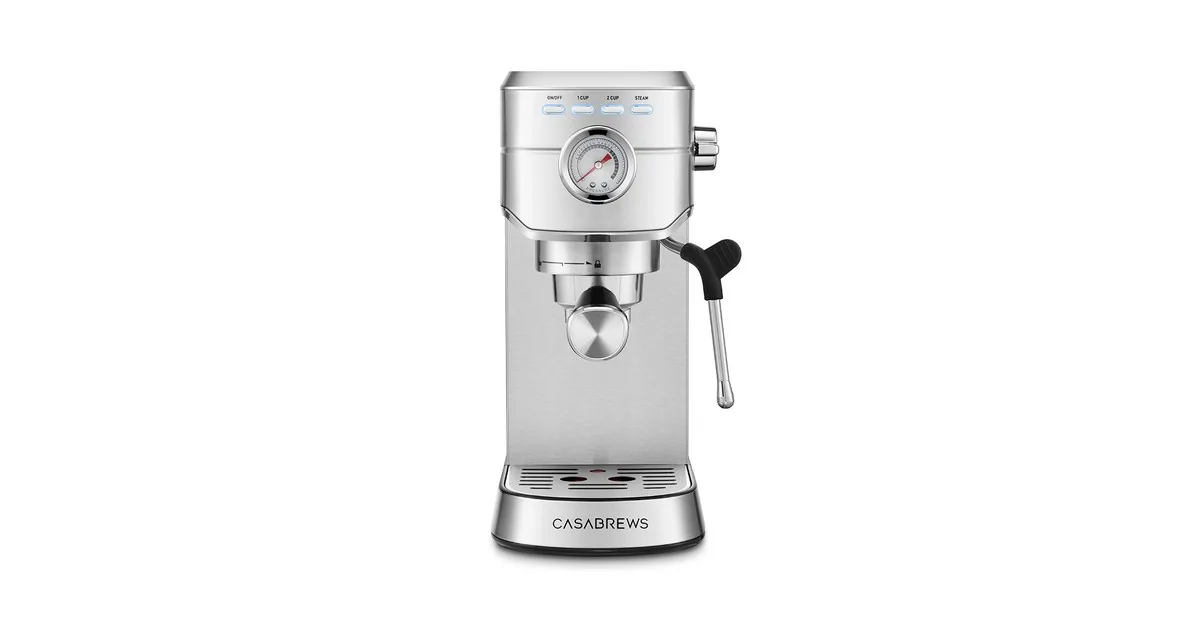
Manufacturer product image of the Gevi ECMG0 straight on: pressure gauge above the group head, steam knob on the right. This site has not photographed the machine. — Source: gevi.com
At a glance
| Model | Gevi ECMG0 |
|---|---|
| Type | Semi-automatic, single boiler, 20-bar rated pump (9 bar optimal extraction per Gevi) |
| Group head | 51 mm |
| Temperature control | PID with NTC sensor |
| Pressure gauge | Yes, on the front panel |
| Steam | Manual steam wand |
| Water tank | 34 oz (1 L) |
| Power | 1350 W, 120 V / 60 Hz |
| Weight | 8.6 lb |
| Dimensions | 12.3"D × 5.5"W × 12"H |
| Body | Stainless steel |
| Price | Not listed here — prices change daily; the retailer link shows the current one |
What those numbers actually mean
51 mm group head. This is the single most important line in the table. It is a standard size, so baskets, tampers and bottomless portafilters are cheap and easy to find. A proprietary size would have locked you out of every upgrade for the life of the machine.
PID with an NTC sensor. A thermostat swings between too cold and too hot; a PID controller holds the boiler near a target. In practice that means the second shot tastes closer to the first instead of drifting. It is the difference between a machine that makes you chase variables and one that lets you blame your grind.
1350 W and 8.6 lb. The wattage is normal for this class and sets how fast it heats. The weight matters more than it sounds: at 8.6 lb you can move the machine to fill the tank at the sink rather than pouring water into it in place — a small thing that comes up every few days.
5.5 inches wide. This is the number that decides whether it fits. Deep machines at this price are usually around 12 inches front to back, and a lot of them will not sit under an upper cabinet. If counter space is why you are shopping, this is the line to compare against everything else.
A real gauge. A needle you can watch during a shot is worth more than any badge on the box, because it tells you when grind, dose or tamp changed the extraction. Two of the three machines in our under-$200 comparison have one.
On the 20-bar figure
Espresso extracts at roughly 9 bar at the group head. A 20-bar rating describes how hard the pump can push, not the pressure the puck sees. Every machine in this price band prints 15 or 20 bar and none of them extracts at 20. Treat the number as headroom, not as a quality ranking — and use the gauge instead.
The limit you will notice: one boiler
This machine has one boiler serving both the brew head and the steam wand. That is a design choice, not a defect, and it has a predictable consequence: steam first, then wait for the boiler to settle before you pull the next shot. Make two lattes in a row and you feel it. Make one drink a day and you never think about it.
The manual steam wand is the second half of that trade. It gives you control over microfoam, and it also means you have to learn. If you want milk textured for you, this is the wrong machine and it is not a price problem — machines that do it for you start much higher in the range.
What 3,814 ratings tell you, and what they do not
The listing averages 4.3 / 5 across 3,814 ratings. That volume is the useful part: at a few dozen reviews you are reading anecdotes, at a few thousand you are reading a distribution, and the low-star reviews start to describe recurring problems rather than one person's bad week.
The distribution matters as much as the average: about 70 percent of the ratings are five stars and about 7 percent are one star, so this is a machine people either like or give up on rather than one that quietly disappoints everybody. As shown on the listing in November 2026, roughly 400 units moved in the past month and the listing ranks second in Amazon's commercial espresso machine category — both signs that the volume is current rather than historical, though retail rankings move and should be re-checked before purchase.
Amazon's own review summary clusters the complaints for us, and two of them are worth knowing before you buy. The first is build and leak: 117 mentions of the housing failing or the machine leaking, which is the failure mode to check in the newest one-star reviews. The second is the portafilter, with 82 mentions of the handle being awkward to lock into place — a daily annoyance rather than a defect, but you will feel it twice a day.
What the average cannot tell you is how this machine performs against the other picks over two years, or whether the failures cluster around a specific part. Sort the listing by one-star and read the newest twenty before you buy anything in this band.
Pros
- 51 mm group head — full aftermarket support for baskets and tampers
- PID temperature control — worth checking, since other machines at this price claim it too
- Working pressure gauge to dial in a shot
- 5.5 in wide and 8.6 lb — genuinely compact and easy to move
- Stainless steel body
- 34 oz tank for one or two drinks a day
Cons
- Single boiler — you wait between steaming and the next shot
- Manual steam wand: a learning curve, not a convenience
- No grinder included; a burr grinder is a separate purchase
- 1 L tank means refilling every few days in a two-person household
Who should buy it
| One espresso or one latte a day | Yes — this is the intended use, and the single boiler never becomes visible. |
|---|---|
| Two drinks back to back | Workable, with a wait between them. Budget for the pause rather than resenting it. |
| Several milk drinks for a family each morning | No. Buy a machine with a dedicated steam circuit instead. |
| Narrow counter or small kitchen | Yes — 5.5 in wide is the reason to pick this over a deeper machine. |
| You want the grinder included | No. See the Gevi model with a built-in conical grinder, or pick 3 in our comparison. |
The upgrade path, and what it costs
Machines in this band ship with pressurised (double-wall) baskets, which are forgiving of a coarse grind and are why the machine works with pre-ground coffee. The moment you switch to a non-pressurised basket for closer-to-cafe espresso, grind consistency becomes the limiting factor, not the machine — and a burr grinder is a separate purchase in the region of $80–100. Budget it before you buy, or choose the model with the grinder built in.
Descaling is the other recurring cost in time rather than money. Hard water is the usual cause of a machine that stops reaching pressure, and the schedule that matters is the one in the manual for the water where you live, not a generic "every few months".
Bottom line
On paper this is the least compromised machine under $200 in our comparison: standard 51 mm group, PID control, a working gauge, and a footprint that fits where a 12-inch machine will not. The cost of that is a single boiler and a manual steam wand, both of which are honest limits rather than flaws. If your routine is one or two drinks a day, it fits. If it is four, it does not.
Check current price · Manufacturer specs
Frequently asked questions
Is it good for beginners?
It is good for a beginner who wants to learn. The 51 mm group head, the PID and the gauge all help you understand what you changed. It does not remove the work: the steam wand is manual and the boiler is shared.
Does 20 bar mean better espresso?
No. Extraction happens around 9 bar at the group head, so 20 bar is pump headroom. Use the gauge, not the number on the box.
Can it brew and steam at the same time?
No. Single boiler: steam, then wait before the next shot.
Does the portafilter size matter?
Yes, and 51 mm is the good news here — baskets, tampers and bottomless portafilters are cheap and easy to find in that size.
Do I need a grinder?
Not with the pressurised baskets it ships with. Once you move to a non-pressurised basket, a burr grinder becomes the biggest factor in taste and a separate $80–100.
Did you test it hands-on?
No. Specs plus owner ratings, with the method published. See how we research.
Sources
- Gevi: Compact Espresso Machine with Milk Frother, 20 Bar — product page and spec sheet
- Gevi: coffee machine range and comparison table (PID, group head, tank and size by model)
- Retail listing — owner rating count and average, checked November 2026
How this review was researched
This is a research-based profile, not a hands-on test. Specifications come from the manufacturer's own product page and range comparison table; owner reaction is taken from the rating count and average on the live retail listing. We did not run instrumented measurements, and we do not publish invented scores. Where the manufacturer does not disclose a specification, we say so rather than estimate it. Prices and availability change without notice — confirm on the listing before buying.
Keep reading
More espresso machine guides