Small Appliances · Product profile
Gevi Dual Boiler Espresso Machine (ECMF0)
Two boilers means steaming stops competing with brewing. A 58 mm non-pressurised basket means the machine stops hiding bad grind. The catch is a 16.5-inch body that needs clearance before anything else.
Affiliate disclosure: Some links on this page are affiliate links. If you buy through them, we may earn a commission at no extra cost to you.
Quick verdict
- What it is: a dual-boiler 20-bar semi-automatic with a built-in multi-step grinder, a 58 mm non-pressurised basket, PID with an NTC sensor, a front pressure gauge and a 2.8 L reservoir.
- Best for: two milk drinks back to back, a counter with at least 17 inches of clearance, and a buyer who wants to learn on a real (non-pressurised) basket.
- Skip it if: your machine sits under an upper cabinet, you already own a good grinder, or you drink one shot a day — a single boiler is cheaper and does the same job.
- Owner signal: 1,648 ratings on the retail listing. That is a real base, but the smallest of the Gevi machines we cover, so treat recurring complaints as patterns to check, not verdicts.
Prices change daily — check the current price on the listing.
Check price at AmazonOpens the retailer's product page. Commission may be earned.
How this page was made: every specification below is from Gevi's own ECMF0 product page and accessory list, checked in November 2026 and linked in Sources. One note on the model name: the retail listing we link sells this machine under a descriptive title rather than the ECMF0 code, so treat the table as the manufacturer's spec sheet for the dual-boiler model and confirm the model number on the listing if that matters to you. We did not test this machine. See how we research.
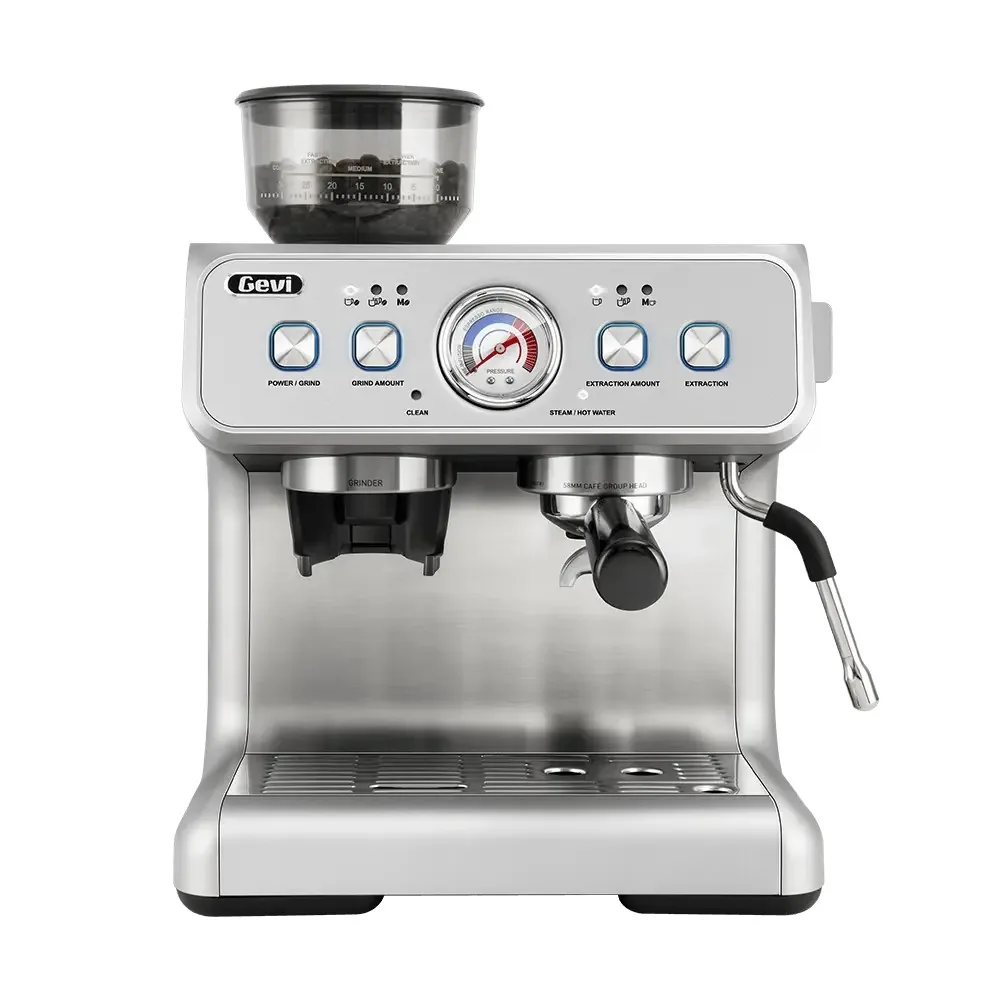
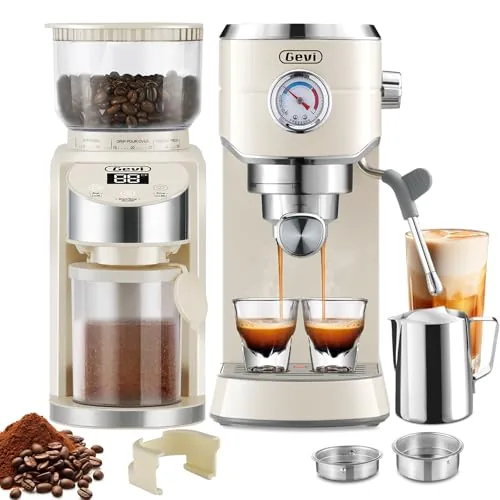
Manufacturer product image of the Gevi ECMF0: four buttons for power/grind, grind amount, extraction amount and extraction, plus the 58 mm group head. This site has not photographed the machine. — Source: gevi.com
At a glance
| Boilers | Dual, brew and steam independent |
|---|---|
| Pump | 20 bar |
| Group head / portafilter | 58 mm |
| Baskets | 58 mm single-wall (non-pressurised), 4 included |
| Temperature control | PID with NTC sensor, adjustable brew temperature |
| Pressure gauge | Yes, front panel |
| Grinder | Built-in, multi-step (30 steps per Gevi's range table), removable hopper |
| Water tank | 2.8 L removable on Gevi's page; the retail listing says 2.3 L |
| Milk | Manual steam wand, 350 ml jug included |
| Dimensions | Gevi page: 12.6"D × 13.8"W × 16.5"H. Retail listing: 12.01"D × 11.5"W × 16.53"H |
| Body | Stainless steel |
| Warranty | 1 year, plus 3 months extended |
| In the box | Machine, hopper, reservoir, 350 ml jug, 58 mm portafilter, 4 single-wall baskets, tamper, cleaning disc, pin, spoon, manual |
| Dose control | 0-30 g adjustable dose; single and double shot volumes selectable |
| Price | Not listed here — check the retail link |
Weight is not published on either page, so we have left it out rather than guess. Two figures above conflict between Gevi's own product page and the retail listing — the tank (2.8 L versus 2.3 L) and the width and depth. Both are plausible for this body, and we are not going to pick one, so both are shown. Treat the retail listing as authoritative for what will actually arrive, and measure the space you have rather than trusting either number.
That table also tells you what this machine is not: there is no pressurised basket in the box, which changes who should buy it more than any other line above.
What two boilers actually buy you
On a single-boiler machine, brewing and steaming share one heating circuit: pull a shot, flip to steam, wait for the boiler to climb, steam, then wait again before the next shot. It works fine for one drink. It falls apart at two, because the second shot is pulled at a temperature the boiler has not settled back to.
A dual boiler removes that queue. Steam and brew are separate, so milk does not cost you the next shot's temperature. Gevi also claims the boilers reach brew readiness in under 30 seconds. If you make two cappuccinos every morning, this is the single line item you are paying for — everything else on this page is secondary.
The 58 mm basket is the bigger change
Fifty-eight millimeters is the commercial standard, and it matters because of what ships in the box: single-wall, non-pressurised baskets. A pressurised basket fakes resistance with a valve, so it will produce something espresso-like from a coarse grind and a sloppy tamp. A non-pressurised basket does not. It reflects your grind, your dose and your tamp straight into the cup.
That is the honest trade: this machine can produce better espresso than the cheaper Gevi models, and it can also produce worse coffee than them on day one, because nothing is compensating for you. Fifty-eight millimeters also means the widest choice of baskets, tampers and bottomless portafilters — the cheapest upgrade path in espresso.
The grinder, and the upgrade you cannot make
A built-in grinder at this price point is a packaging decision, not a quality claim. It saves a purchase and a footprint, and with 30 steps it is adjustable enough for espresso. What it cannot do is get replaced. Grinders are the component people outgrow first; on this machine, outgrowing it means replacing the machine.
Owner comments on the product page describe the auto-grind cycle occasionally overfilling the portafilter. That is a dosing behavior, not a failure, but it is worth knowing before you buy if you plan to weigh your dose.
16.5 inches is the real constraint
Depth and width are manageable at 12.6 and 13.8 inches. Height is not: 16.5 inches plus a hopper on top. Most upper cabinets sit around 18 inches above the counter, so this machine fits — barely — and leaves no room to pour beans in without pulling it forward. Measure before you buy. This is the line that sends machines back, not the boiler count.
The 2.8 L reservoir is the largest in the Gevi range, which matters more than it sounds: on a machine this tall, refilling usually means moving it, and moving it means re-levelling the cup tray.
What 1,648 ratings can and cannot tell you
The listing carries 1,648 ratings — enough that recurring complaints repeat, but a smaller base than the cheaper Gevi models, which means each one-star review carries more weight in the average. Read the newest negative reviews for the two things a spec sheet cannot show: whether the grinder stays consistent after months, and whether the steam wand's manual valve is pleasant to use.
Pros
- Dual boiler: steam and brew do not compete
- 58 mm non-pressurised baskets — a real espresso workflow, and cheap accessories
- PID with NTC and an adjustable brew temperature
- Front pressure gauge as a diagnostic, not decoration
- 2.8 L tank, 350 ml jug, four baskets and a tamper in the box
Cons
- 16.5 in tall before the hopper — check cabinet clearance first
- Built-in grinder cannot be upgraded independently
- Non-pressurised basket punishes a bad grind; there is a learning curve
- Weight not published; 1-year base warranty
Who should buy it
| Two or more milk drinks every morning | Yes — this is the machine's reason to exist. |
|---|---|
| One straight shot a day | No. A single-boiler machine costs less and does the same job. |
| Counter under an 18-inch cabinet | Measure first. 16.5 in plus hopper leaves almost no headroom. |
| You already own a burr grinder | No — you would pay for grinding you have. |
| You want to learn on a real basket | Yes — 58 mm non-pressurised is the right classroom. |
| You will upgrade the grinder in a year | No. Buy a machine without a built-in grinder. |
If this is not the one
If you want the grinder included but at a lower price, the Gevi with built-in grinder is the smaller sibling. If you would rather buy the machine and add a grinder separately, the Gevi 20 Bar Compact has a full published spec sheet, a 51 mm group head and a much smaller footprint — and the Tornado Basic grinder fits it. For the whole field on one table, see the under-$200 roundup.
Bottom line
This machine is worth it for exactly one reason: you make two milk drinks in a row and you are tired of waiting on a single boiler. Everything else here — 58 mm baskets, PID, the gauge, the 2.8 L tank — makes that case stronger, but none of it is unique at this price. If you make one drink a day, buy the cheaper compact and spend the difference on a grinder you can keep.
Frequently asked questions
What does a dual boiler change in daily use?
Steam and brew stop competing, so pulling a second shot does not mean waiting for the boiler to settle. For one drink a day that difference barely registers; for two or more it defines the machine.
Is the 58 mm basket pressurised?
No. The ECMF0 ships with 58 mm single-wall (non-pressurised) baskets. That is better for flavor and less forgiving of grind and tamp — you will notice your grinder's limits quickly.
Will it fit under my kitchen cabinets?
It is 16.5 inches tall before the hopper. Most upper cabinets sit about 18 inches above the counter, so it fits with very little headroom. Measure clearance and the height of your bean hopper before buying.
Can I use a different grinder with it?
You can grind elsewhere and dose manually, but the built-in grinder cannot be swapped out. If grinding flexibility matters, buy a machine without one.
How large is the water tank?
2.8 liters, removable — the largest tank in Gevi's espresso range, and useful here because refilling a 16.5-inch machine usually means moving it.
Sources
- Gevi: Dual Boiler Espresso Machine ECMF0 — specs, box contents, PID/NTC, 58 mm, 2.8 L reservoir, dimensions
- Gevi: espresso range comparison table — dual boiler, 30-step grinder, 58 mm group head, gauge
- Gevi: accessory list — 58 mm non-pressurised basket and portafilter for ECMF0
- Retail listing for the machine profiled here — owner ratings and current price
How this page was researched
Research-based profile, not a hands-on test. We did not measure pressure, grind consistency, temperature stability or brew time. Specifications come from the manufacturer's and retailer's published pages; where a value is not published we say so instead of estimating it. Prices and availability change without notice — confirm on the listing before buying.
Keep reading